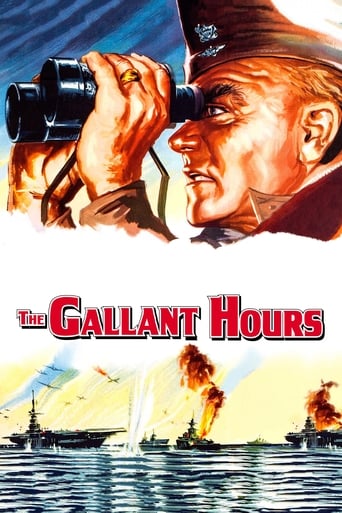
东京湾受降记 (1960)
The Gallant Hours
故事聚焦于 1942 年二战南太平洋战局最黑暗、最关键的五周时间里,临危受命出任南太平洋盟军总司令的“蛮牛”威廉·F·哈尔西海军中将,在面对瓜达尔卡纳尔岛美军补给几乎中断、纳粹同盟大日本帝国海军攻势如潮的绝境下,如何顶住难以想象的心理高压与责任重担,在幕后指挥部里排兵布阵、稳定军心,与日军大将山本五十六展开一场看不见硝烟的意志与战略博弈,并最终力挽狂澜扭转整个太平洋战争走向的传奇历程。
演员阵容
- James Cagney — Admiral William 'Bull' Halsey
- 丹尼斯·韦弗 — Andy Lowe
- Ward Costello — Harry Black
- 沃恩·泰勒 — Mike Pulaski
- 理查德·杰克尔 — Roy Webb
- 莱斯·特里梅因 — Frank Enright
- Walter Sande — Horace Keys ("Doc")
- Karl Swenson — Bill Bailey
- Richard Carlyle — Father Gehring
- Carl Benton Reid — Robert Ghormley
- 威廉·沙勒特 — Thomas G. Lamphier Jr.
- 雷蒙德·贝利 — Vandergrift
趣闻
The Gallant Hours is a 1960 American docudrama about William F. Halsey, Jr. and his efforts in fighting against Admiral Isoroku Yamamoto and the Imperial Japanese Navy in the Guadalcanal campaign of World War II.
Production
Director Robert Montgomery had served under Admiral William F. Halsey, Jr., as a Commander in the U.S. Navy during World War II, and he came up with the idea of making a film about Halsey when he attended the 75th birthday celebration honoring the Admiral in 1957.
Under his contract agreement with Cagney-Montgomery Productions, Admiral Halsey would receive 10 percent of the profits from the motion picture. During a visit with his son, William F. Halsey III, in La Jolla, California, Admiral Halsey went to Camp Pendleton where The Gallant Hours was being filmed (pictured). William F. Halsey III later remarked that he was startled at how much James Cagney looked like his father did during World War II.
The voiceover narration technique Montgomery used was similar to what he had done in Lady in the Lake, although in that case the narration was in the first person. What is striking about the narrative in The Gallant Hours is the degree of detail provided to introduce both main and minor characters to the audience, even sometimes indicating the manner of their death in the near future.
For James Cagney, The Gallant Hours was "a labor of love, a tribute to that wonderful man Admiral William F. 'Bull' Halsey" for himself and his friend Robert Montgomery. Cagney praised Montgomery because he "steered away from big battle scenes and roaring guns. We concentrated on Halsey himself, trying to convey some of the tension of high command" in the film.
The Gallant Hours was filmed in black & white at Metro-Goldwyn-Mayer Studios in the spring of 1959, with some exterior scenes shot in San Diego. The film employed a new construction technique to make the interior battleship shots easier to move and light: the walls of sets were hung from overhead grids to enable them to swing in and out as needed. Working titles for the film were "Bull Halsey" and "The Admiral Halsey Story".
在维基百科阅读更多 · 文本来自维基百科,CC BY-SA 4.0。数据来自 Wikidata。