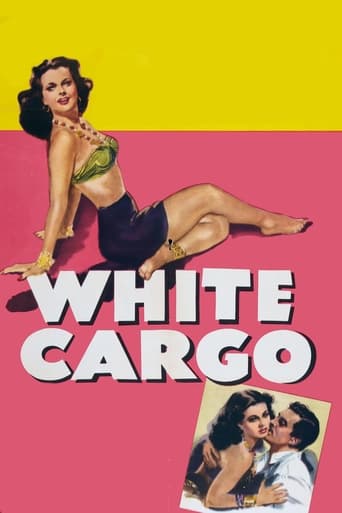
White Cargo (1942)
"I am TONDELAYO"
In Africa early in World War II, a British rubber plantation executive reminisces about his arrival in the Congo in 1910. He tells the story of a love-hate triangle involving Harry Witzel, an in-country station superintendent who'd seen it all, Langford, a new manager sent from England for a four-year stint, and Tondelayo, a siren of great beauty who desires silk and baubles. Witzel is gruff and seasoned, certain that Langford won't be able to cut it. Langford responds with determination and anger, attracted to Tondelayo because of her beauty, her wiles, and to get at Witzel. Manipulation, jealousy, revenge, and responsibility play out as alliances within the triangle shift.
- Date of release
- 1942-12-12
- TMDB
- 6.2 / 10 (8)
- Runtime
- 1h 28m
- Genres
- Adventure, Drama
- Director
- Richard Thorpe
Casting
- Hedy Lamarr — Tondelayo
- Walter Pidgeon — Mr. Harry Witzel
- Frank Morgan — The Doctor
- Richard Carlson — Mr. Langford
- Reginald Owen — Skipper of the Congo Queen
- Henry O'Neill — The Reverend Dr. Roberts
- Bramwell Fletcher — Wilbur Ashley
- Clyde Cook — Ted, First Mate of the Congo Queen
- Leigh Whipper — Jim Fish
- Oscar Polk — Umeela
- Darby Jones — Darby
- Richard Ainley — Mr. Worthing
Interesting facts
- Budget: $570K
White Cargo is a 1942 American drama film starring Hedy Lamarr and Walter Pidgeon, and directed by Richard Thorpe. Released by Metro-Goldwyn-Mayer, it is based on the 1923 London and Broadway hit play by Leon Gordon, which was in turn adapted from the 1912 novel Hell's Playground by Ida Vera Simonton. The play had already been made into a British part-talkie, also titled White Cargo, with Maurice Evans in 1930. The 1942 film, unlike the play, begins in what was then the present-day, before unfolding in flashback.
Production
In 1930, Gordon sold the film rights to British International Pictures (BIP) for £15,000. The company then decided to make a sound version and paid Gordon an extra £10,000 for talking rights. The British film version followed the play closely. MGM bought the film rights from BIP and hired Gordon to adapt his own play.
According to the Production Code Administration section of the file on the film in the Motion Picture Association of America collection at the Margaret Herrick Library of the Academy of Motion Picture Arts and Sciences, the miscegenation element - a white man becoming intimately involved with a native African woman - of Leon Gordon's story caused great censorship difficulties, beginning with the U.S.
In the play, Tondelayo is described throughout as a "negress." The March 1930 New York release of the 1929 British film, directed by J. B. Williams and Arthur Barnes, starring Leslie Faber, in the U.S. violated the spirit of Hays' decree.
As noted in articles included in the MPAA/PCA files, in accordance with the MPPDA's 1924 agreement of self-imposed censorship, MPPDA head Will Hays deemed the play unacceptable for screen adaptation under the Motion Picture Production Code, effectively banning any studios from producing it.
Tondelayo's ethnicity was therefore changed for the movie, turned into an exotic Arab. In Gordon's original script this fact was to be revealed at the end, but the censor requested the information be revealed earlier. To comply, it was introduced as part of the marriage controversy, which is far more over Tondelayo's character and behavior than her race.
Read on Wikipedia · Text from Wikipedia, CC BY-SA 4.0. Data from Wikidata.
Recommended
- Dark of the Sun 1968 · ★ 6.6
- Tarzan and His Mate 1934 · ★ 6.5
- Little Lord Fauntleroy 1980 · ★ 7.3
- Iron Will 1994 · ★ 6.7
- True Spirit 2023 · ★ 7.0
- The Black Pirate 1926 · ★ 6.7
- All That Money Can Buy 1941 · ★ 7.0
- Where the Red Fern Grows 2003 · ★ 6.6
- True Grit 1969 · ★ 7.3
- Kings of the Sun 1963 · ★ 6.1
- Where the Red Fern Grows 1974 · ★ 6.9
- Moondance Alexander 2007 · ★ 6.0