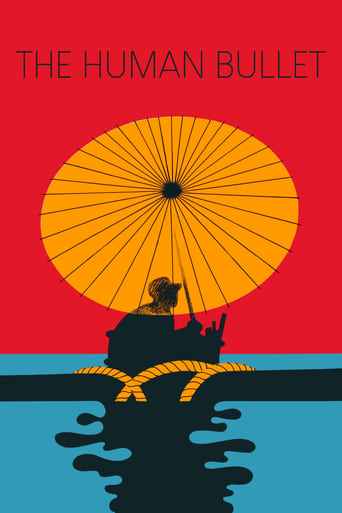
The Human Bullet (1968)
肉弾
Kamikaze funeral pyre
A soldier has been in the Japanese military for the entirety of WWII, and in that time, his dedication to the army has never faltered. However, as the war draws to a close, his commanding officers become increasingly desperate and push their men to ever more absurd extremes. The ridiculousness of the orders from above peak when the hero of the story is assigned to drive a one-man submarine straight into the hull of an enemy battleship.
- Date of release
- 1968-10-22
- TMDB
- 6.0 / 10 (15)
- Runtime
- 1h 56m
- Genres
- Comedy, Drama, War
- Director
- Kihachi Okamoto
Casting
- Minori Terada — Him
- Naoko Ohtani — The Girl
- Hideyo Amamoto — Father
- Masao Imafuku — School Principal
- Chishū Ryū — Bookstore Owner
- Tanie Kitabayashi — Bookstore Owner's Wife
- Masumi Harukawa — Woman in Apron
- Hirohisa Sonoda — Teacher
- Shoichi Ozawa — Sergeant
- Kin Sugai — Sergeant's Wife
- Sue Mitobe — Woman
- Yoshitaka Zushi — Older Brother
Interesting facts
The Human Bullet is a 1968 Japanese satiric anti-war film about a soldier who becomes assigned to a suicide mission against the American forces during the late stage of World War II. It was written and directed by Kihachi Okamoto, based off his own wartime experiences.
Production
After negotiations with Toho Studios failed, Okamoto financed The Human Bullet himself, shooting it on 16mm film (to be later released in 35 mm format). Independent distribution and production company Art Theatre Guild acted as co-producer.
The film was based on Okamoto's own wartime experiences. As no film studio would provide funding, the director's wife, Mineko Okamoto, stepped up as producer. Working side-by-side, the couple painstakingly raised the necessary funds themselves, eventually managing to bring the production to fruition. It is said that Okamoto even mortgaged his own home to secure the production budget.
Naoko Otani, who was still a high school student at the time, agreed to appear nude in the film. "I don't consider it shameful at all," Ohtani remarked. "While I dislike being gawked at out of mere curiosity, when viewed within the context of the work as a whole, those shots are entirely meaningful." She also made bold statements regarding director Kihachi Okamoto—then in his mid-forties—for whom she had developed a deep admiration: "I have never…
Read on Wikipedia · Text from Wikipedia, CC BY-SA 4.0. Data from Wikidata.
Recommended
- The Secret of Santa Vittoria 1970 · ★ 6.9
- Mister Roberts 1955 · ★ 7.0
- Little Boy 2015 · ★ 7.3
- Catch-22 1970 · ★ 6.7
- What Did You Do in the War, Daddy? 1966 · ★ 5.9
- The Beast of War 1988 · ★ 7.1
- M*A*S*H 1970 · ★ 6.9
- Oh! What a Lovely War 1969 · ★ 6.6
- The Long Voyage Home 1940 · ★ 6.6
- Inglourious Basterds 2009 · ★ 8.2
- The Greatest Beer Run Ever 2022 · ★ 7.5
- Hot Shots! 1991 · ★ 6.6