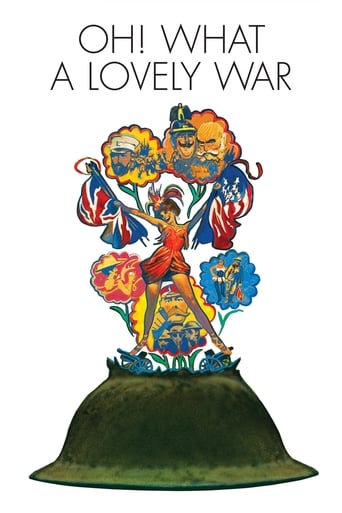
Oh! What a Lovely War (1969)
The ever popular war games. With songs, battles & a few jokes.
The working-class Smiths change their initially sunny views on World War I after the five boys of the family witness the harsh reality of trench warfare.
- Date of release
- 1969-03-10
- TMDB
- 6.7 / 10 (56)
- Runtime
- 2h 24m
- Genres
- Comedy, Music, War
- Director
- Richard Attenborough
Casting
- Laurence Olivier — Field Marshal Sir John French
- Vanessa Redgrave — Sylvia Pankhurst
- Maggie Smith — Music Hall Star
- John Mills — Field Marshall Sir Douglas Haig
- Corin Redgrave — Bertie Smith
- Maurice Roëves — George Smith
- Ian Holm — President Poincare
- Juliet Mills — Nurse
- Michael Bates — Drunk Lance Corporal
- Edward Fox — Aide to Field-Marshal Haig
- Dirk Bogarde — Stephen
- Jean-Pierre Cassel — French Colonel
Interesting facts
- Based on: Oh What a Lovely War
- Filmed in: Brighton, West Pier, Ditchling Beacon, and Twickenham Film Studios
Oh! What a Lovely War is a 1969 British satirical film directed by Richard Attenborough, with an ensemble cast, including Maggie Smith, Dirk Bogarde, John Gielgud, John Mills, Kenneth More, Laurence Olivier, Jack Hawkins, Corin Redgrave, Michael Redgrave, Vanessa Redgrave, Ralph Richardson, Ian Holm, Paul Shelley, Malcolm McFee, Jean-Pierre Cassel, Nanette Newman, Edward Fox, Susannah York, John Clements, Phyllis Calvert and Maurice Roëves.
Production
The film is based on the eponymous stage musical, originated by Charles Chilton as the radio play The Long Long Trail in December 1961, and transferred to stage by Gerry Raffles in partnership with Joan Littlewood and her Theatre Workshop in 1963.
The producers were the novelist Len Deighton, photographer Brian Duffy and Richard Attenborough, who was making his directorial debut. The Deighton Duffy production company had produced the film adaptation of Deighton's Only When I Larf starring Richard Attenborough.
The 1969 film transferred the mise-en-scène completely into the cinematic domain, with elaborate sequences shot at West Pier in Brighton, elsewhere in Brighton and on the South Downs, interspersed with motifs from the stage production. These included the 'cricket' scoreboards showing the number of dead, but Deighton did not use the pierrot costumes.
The film was shot in the summer of 1968 in Sussex, mostly in the Brighton area. Many of the extras were local people, but a great many were students from the University of Sussex, Falmer, on the outskirts of the town. The film's locations included the West Pier (now gutted by fire and wrecked), Ditchling Beacon, Sheepcote Valley (the trench sequences), Old Bayham Abbey, near Frant (the church parade), Brighton station and Ovingdean (where thousan…
The song was written by J. P. Long and Maurice Scott in 1917 and was part of the repertoire of music hall star and male impersonator Ella Shields. The first verse and the chorus follow:
Read on Wikipedia · Text from Wikipedia, CC BY-SA 4.0. Data from Wikidata.
Recommended
- What Did You Do in the War, Daddy? 1966 · ★ 5.9
- Carry On Sergeant 1958 · ★ 6.4
- Duck Soup 1933 · ★ 7.3
- The Devil's Disciple 1959 · ★ 6.6
- Head 1968 · ★ 6.2
- Rock 'n' Roll High School 1979 · ★ 6.3
- Pack Up Your Troubles 1932 · ★ 6.8
- The Great Dictator 1940 · ★ 8.3
- CB4 1993 · ★ 6.1
- The Russians Are Coming! The Russians Are Coming! 1966 · ★ 6.4
- Hot Shots! Part Deux 1993 · ★ 6.6
- Hot Shots! 1991 · ★ 6.6