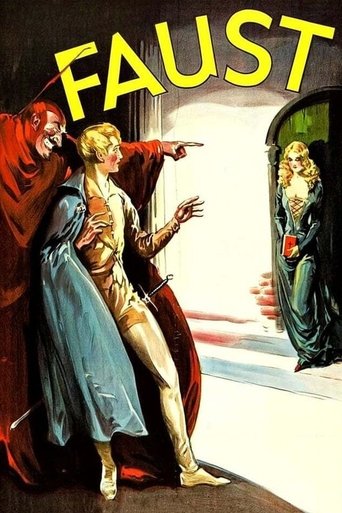
Faust (1926)
Faust - Eine deutsche Volkssage
The Voice of the Tempter.
Murnau’s epic adaptation of Goethe’s tragedy stands with Fritz Lang’s Metropolis among the supreme achievements of German silent cinema. Gösta Ekman plays the alchemist who, his faith shaken in a time of plague, is offered the gift of healing and eternal youth… in exchange for his soul.
- Date of release
- 1926-10-14
- TMDB
- 7.9 / 10 (425)
- Runtime
- 1h 46m
- Genres
- Fantasy, Drama, Horror
- Director
- F. W. Murnau
Casting
- Gösta Ekman — Faust
- Emil Jannings — Mephisto
- Camilla Horn — Gretchen Marguerite
- Frida Richard — Gretchens's Mother
- William Dieterle — Valentin
- Werner Fuetterer — Erzengel
- Yvette Guilbert — Marthe Schwerdtlein
- Eric Barclay — Duke of Parma
- Hanna Ralph — Duchess of Parma
- Hans Brausewetter — Farmboy (uncredited)
- Lothar Müthel — Friar (uncredited)
- Hertha von Walther — (uncredited)
Interesting facts
Faust – A German Folktale is a 1926 silent fantasy film, produced by Ufa, directed by F. W. Murnau, starring Gösta Ekman as Faust, Emil Jannings as Mephisto, Camilla Horn as Gretchen/Marguerite, Frida Richard as her mother, Wilhelm Dieterle as her brother, and Yvette Guilbert as Marthe Schwerdtlein, her aunt. Murnau's film draws on older traditions of the legendary tale of Faust as well as on Goethe's classic 1808 version. Ufa wanted Ludwig Berger to direct Faust, as Murnau was engaged with Variety; Murnau pressured the producer and, backed by Jannings, eventually persuaded Erich Pommer to let him direct the film.
Production, release history and restoration
Murnau's Faust was the most technically elaborate and expensive production undertaken by Ufa until it was surpassed by Metropolis the following year. Filming took six months, at a cost of 2 million ℛ︁ℳ︁ (only half was recovered at the box office). According to film historians, Faust seriously affected studio shooting and special effects techniques. Murnau uses two cameras, both filming multiple shots; many scenes were filmed time and again.
The task of writing the intertitles was originally assigned to Hans Kyser, a German novelist and playwright who had moved into screenwriting. He decided to combine various lines from the original folk tale, Christopher Marlowe's Doctor Faustus and Goethe's Faust, Part 1, as well as providing some of his own.
The film received a pre-release showing with Hauptmann's intertitles at the Ufa-Pavillon am Nollendorfplatz on 26 August 1926. Unfortunately, Ufa's directors felt that Hauptmann's titles were even worse: Ufa informed Hauptmann just a week before the premiere of "unexpected difficulties", and in the end Faust opened with Kyser's intertitles at the Ufa-Palast am Zoo on 14 October 1926.
There were several versions created of Faust, several of them prepared by Murnau himself. The versions are quite different from one another. Some scenes have variants on pace, others have actors with different costumes and some use different camera angles. For example, a scene with a bear was shot with both a person in costume and an actual bear. In some versions, the bear simply stands there. In one version, it actually strikes an actor.
Overall, five versions of Faust are known to exist out of the over thirty copies found across the globe: a German original version (of which the only surviving copy is in the Danish Film Institute), a French version, a late German version which exists in two copies, a bilingual version for Europe prepared by Ufa and a version prepared in July, 1926 by Murnau himself, for release in the U.S. market by Metro-Goldwyn-Mayer.
Read on Wikipedia · Text from Wikipedia, CC BY-SA 4.0. Data from Wikidata.
Recommended
- A Christmas Carol 1984 · ★ 7.5
- The Cabinet of Dr. Caligari 1920 · ★ 7.9
- Avalon High 2011 · ★ 6.2
- The Witches 1990 · ★ 7.0
- Vampyr 1932 · ★ 7.2
- Something Wicked This Way Comes 1983 · ★ 6.5
- The Golem: How He Came into the World 1920 · ★ 7.0
- Before I Fall 2017 · ★ 7.0
- The Adventures of Ichabod and Mr. Toad 1949 · ★ 6.5
- The Unhealer 2021 · ★ 5.8
- The Curse of the Werewolf 1961 · ★ 6.5
- The Lovely Bones 2009 · ★ 7.1