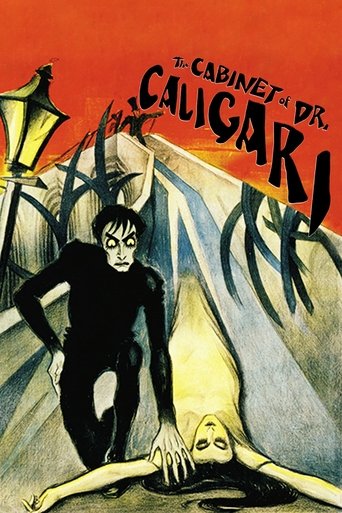
The Cabinet of Dr. Caligari (1920)
Das Cabinet des Dr. Caligari
You must become Caligari!
Francis, a young man, recalls in his memory the horrible experiences he and his fiancée Jane recently went through. Francis and his friend Alan visit The Cabinet of Dr. Caligari, an exhibit where the mysterious doctor shows the somnambulist Cesare, and awakens him for some moments from his death-like sleep.
- Date of release
- 1920-02-27
- TMDB
- 7.9 / 10 (1863)
- Runtime
- 1h 16m
- Genres
- Drama, Horror, Thriller, Crime
- Director
- Robert Wiene
Casting
- Werner Krauss — Dr. Caligari
- Conrad Veidt — Cesare
- Friedrich Fehér — Francis
- Lil Dagover — Jane
- Hans Heinrich von Twardowski — Alan
- Rudolf Lettinger — Dr. Olsen
- Henri Peters-Arnolds — Young Doctor (uncredited)
- Rudolf Klein-Rogge — Criminal (uncredited)
- Hans Lanser-Rudolf — Old Man (uncredited)
- Ludwig Rex — Murderer (uncredited)
- Elsa Wagner — Landlady (uncredited)
Interesting facts
- Budget: $12.4K
The Cabinet of Dr. Caligari is a 1920 German silent horror film directed by Robert Wiene and written by Hans Janowitz and Carl Mayer. The quintessential work of early German Expressionist cinema, it tells the story of a hypnotist who uses a somnambulist Cesare to commit murders. The film features a dark, twisted visual style, with sharp-pointed forms; oblique, curving lines; structures and landscapes that lean and twist in unusual angles; and shadows and streaks of light painted directly onto the sets.
Production
The Cabinet of Dr. Caligari was written by Hans Janowitz and Carl Mayer, both of whom were pacifists by the time they met following World War I. Janowitz served as an officer during the war, but the experience left him embittered with the military, which affected his writing. Mayer feigned madness to avoid military service during the war, which led him to intense examinations from a military psychiatrist.
Although neither had any associations with the film industry, Janowitz and Mayer wrote a script over six weeks during the winter of 1918–19. In describing their roles, Janowitz called himself "the father who planted the seed, and Mayer the mother who conceived and ripened it". The Expressionist filmmaker Paul Wegener was among their influences.
Janowitz and Mayer are said to have set out to write a story denouncing arbitrary authority as brutal and insane. Janowitz said it was only years after the film was released that he realised exposing the "authoritative power of an inhuman state" was the "subconscious intention" of the writers. Hermann Warm, who designed the film's sets, said Mayer had no political intentions when he wrote the film.
The film they wrote was entitled Das Cabinet des Dr. Caligari, using the English spelling Cabinet rather than the German Kabinett. The completed script contained 141 scenes. Janowitz has claimed the name Caligari, which was not settled upon until after the script was finished, was inspired by a rare book called Unknown Letters of Stendhal, which featured a letter from the French novelist Stendhal referring to a French officer named Caligari he me…
The story of Caligari is told abstractly, like a fairy tale, and includes little description about or attention toward the psychological motivations of the characters, which is more heavily emphasised in the film's visual style. The original script shows few traces of the Expressionist influence prevalent in the film's sets and costumes.
Read on Wikipedia · Text from Wikipedia, CC BY-SA 4.0. Data from Wikidata.
Recommended
- Spellbound 1945 · ★ 7.4
- The Truth About Emanuel 2013 · ★ 6.0
- The Caveman's Valentine 2001 · ★ 5.9
- Night Watch 1973 · ★ 6.3
- We Go On 2016 · ★ 5.8
- The Naked City 1948 · ★ 7.2
- Insomnia 2002 · ★ 7.0
- The Nightmare 2015 · ★ 6.4
- The Eternal Daughter 2022 · ★ 5.9
- The House on Carroll Street 1988 · ★ 6.0
- Killer's Kiss 1955 · ★ 6.3
- The Face Behind the Mask 1941 · ★ 6.5