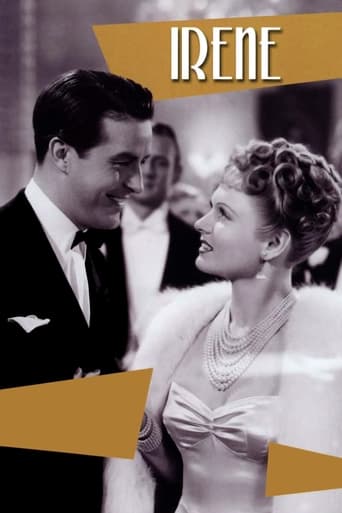
Irene (1940)
Glorious musical comedy of the girl in the Alice Blue Gown!
Upholsterer's assistant Irene O'Dare meets wealthy Don Marshall while she is measuring chairs for Mrs. Herman Vincent at her Long Island estate. Charmed by her, Don anonymously purchases Madame Lucy's, an exclusive Manhattan boutique, and instructs newly hired manager Mr. Smith to offer Irene a job as a model. She soon catches the eye of socialite Bob Vincent, whose mother is hosting a ball at the family mansion. To promote Madame Lucy's dress line, Mr. Smith arranges for his models to be invited to the ball.
- Date of release
- 1940-04-23
- TMDB
- 6.5 / 10 (8)
- Runtime
- 1h 41m
- Genres
- Comedy, Romance, Music
- Director
- Herbert Wilcox
Casting
- Anna Neagle — Irene O'Dare
- Ray Milland — Don Marshall
- Roland Young — Mr. Smith
- Alan Marshal — Bob Vincent
- May Robson — Granny O'Dare
- Billie Burke — Mrs. Herman Vincent
- Arthur Treacher — Bretherton
- Marsha Hunt — Miss Eleanor Worth
- Isabel Jewell — Jane McGee
- Doris Nolan — Lillian
- Stuart Robertson — Freddie
- Ethel Griffies — Princess Minetti
Interesting facts
- Awards: 0 · Nominations: 1
Irene is a 1940 American musical film produced and directed by Herbert Wilcox. The screenplay by Alice Duer Miller is based on the libretto of the 1919 stage musical Irene by James Montgomery, who had adapted it from his play Irene O'Dare. The score features songs with music by Harry Tierney and lyrics by Joseph McCarthy.
Production
For nearly two decades following its original 1919 production at the Vanderbilt Theatre, Irene — with a total run of 675 performances — held the record for the longest-running show in Broadway theatre history. In addition to the 1926 silent film Irene, the musical also was adapted for a June 1936 Lux Radio Theatre production starring Jeanette MacDonald and Regis Toomey.
The film was shot in black and white with the exception of a Technicolor sequence that begins at Mrs. Vincent's society ball when Bretherton's jaw drops as he looks up to see Irene coming downstairs. Don and Irene dance to an instrumental version of "Alice Blue Gown," and the sequence ends at the O'Dare's apartment, where Irene sings the song to her grandmother and friend.
The song is replayed as an installment of Rex Gordon's Moviebone News, a spoof of the Movietone News shorts that were popular at the time. Irene's dress—and the song—have become world-famous, and performers from Peoria to Paris, from Hawaii to Harlem give their versions of the song.
Johnny Long and His Orchestra make cameo appearances in the film.
This version downplays the "Madame Lucy" character. Other versions of Irene present "Lucy" as a very campy gay man.
Read on Wikipedia · Text from Wikipedia, CC BY-SA 4.0. Data from Wikidata.
Recommended
- Easter Parade 1948 · ★ 7.1
- Funny Face 1957 · ★ 7.0
- Top Hat 1935 · ★ 7.2
- The Harvey Girls 1946 · ★ 6.6
- How to Marry a Millionaire 1953 · ★ 6.8
- Another Cinderella Story 2008 · ★ 7.3
- Summer Stock 1950 · ★ 6.7
- The Tender Trap 1955 · ★ 6.2
- Les Girls 1957 · ★ 6.4
- Dancing Lady 1933 · ★ 6.9
- Let's Make Love 1960 · ★ 6.4
- Finding Emily 2026 · ★ 6.9