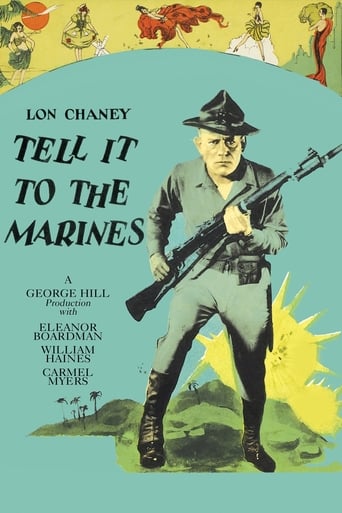
Tell It to the Marines (1926)
U.S. Marine Sergeant O'Hara has his hands full training raw recruits, one of whom, 'Skeets' Burns, is a particular thorn in his side. If Burns's lackadaisical approach to the military were not bad enough, he also makes advances on nurse Nora Dale, whom Sergeant O'Hara secretly loves. Nora is oblivious to O'Hara's feelings and is attracted to the handsome 'Skeet.' But an indiscretion turns her against him, and it takes an expedition to China and a battle with a warlord's bandit brigade to sort things out among the nurse and her two Marines.
- Date of release
- 1926-12-23
- TMDB
- 6.5 / 10 (20)
- Runtime
- 1h 43m
- Genres
- Action, Comedy, Drama
- Director
- George W. Hill
Casting
- Lon Chaney — Sergeant O'Hara
- William Haines — Private Skeet Burns
- Eleanor Boardman — Norma Dale
- Eddie Gribbon — Corporal Madden
- Carmel Myers — Zaya
- Warner Oland — Chinese Bandit Chief
- Mitchell Lewis — Native
- Frank Currier — General Wilcox
- Maurice E. Kains — Harry
- Lori Bara — Navy Nurse
- Dick Curtis — Marine in Barracks
- Nola Luxford — Navy Nurse
Interesting facts
Tell It to the Marines is a 1926 American silent romantic drama film directed by George W. Hill and starring Lon Chaney, William Haines, and Eleanor Boardman. The film follows a Marine recruit and the sergeant who trains him. It was the biggest box office success of Chaney's career and the second biggest moneymaker of 1926/1927.
Background
The film premiered in New York City on December 23, 1926.
MGM brought in General Smedley D. Butler, commander of the Marine base in San Diego and subsequently the author of the anti-war book War Is a Racket, for technical consultation on the film. Lon Chaney formed a close friendship with the Marine Corps general which lasted for the rest of Chaney's life.
The studio was also allowed to shoot on Marine Corps Recruit Depot San Diego which made Tell It to the Marines the first motion picture made with the full cooperation of the U.S. Marine Corps. Battleship USS California (later involved in the attack on Pearl Harbor on December 7, 1941) was used for the scenes at sea and the final sequence of the film, where the Marines rescue the hostages, was filmed at Iverson Ranch in Chatsworth, California, the…
The film was shot concurrently with Pathé's film serial The Fighting Marine with Gene Tunney and Fox's What Price Glory? leading MGM and Fox to bicker over which studio had rights to use the name of the U.S. Marine Corps. The films began a genre of films depicting the Marines putting down insurrections around the world until RKO's The Marines Fly High (1940) when World War II exploits became the norm.
Read on Wikipedia · Text from Wikipedia, CC BY-SA 4.0. Data from Wikidata.
Recommended
- Annapolis 2006 · ★ 6.9
- The Enforcer 2022 · ★ 7.0
- The Black Pirate 1926 · ★ 6.7
- Walking Tall 2004 · ★ 6.4
- Semper Fi 2019 · ★ 6.0
- G.I. Jane 1997 · ★ 6.5
- Stripes 1981 · ★ 6.6
- They Were Expendable 1945 · ★ 6.5
- Flying Tigers 1942 · ★ 6.3
- Sniper 1993 · ★ 6.2
- Greyhound 2020 · ★ 7.4
- The Woman King 2022 · ★ 7.5