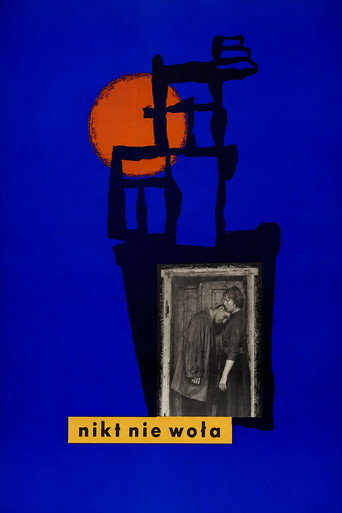
Nobody's Calling (1960)
Nikt nie woła
Shortly after World War 2 a young man arrives on the Recovered Territories and starts a romance with a young woman, all the while evading the ghosts of his past.
- Date of release
- 1960-10-31
- TMDB
- 7.0 / 10 (10)
- Runtime
- 1h 26m
- Genres
- War, Drama, Romance
- Director
- Kazimierz Kutz
Casting
- Zofia Marcinkowska — Lucyna
- Henryk Boukołowski — Bożek 'Bohdan Nieczuja'
- Barbara Krafftówna — Niura
- Halina Mikołajska — Olga Stareńska
- Aleksander Fogiel — 'Mayor'
- Ryszard Pietruski — Zygmunt
- Laura Debicka — Alicja
- Michaj Burano — Singing Man (uncredited)
- Irena Jaglarzowa — Niura's Mother (uncredited)
- Stanisław Tym — (uncredited)
- Andrzej Zamięcki — Stefek (uncredited)
Interesting facts
Nikt nie woła is a Polish black-and-white narrative film from 1960, directed by Kazimierz Kutz, loosely based on the novel of the same title by Józef Hen. The film tells the post-war story of a deserter from the anti-communist underground who tries to settle in a former German town and becomes infatuated with one of the local women.
Production
Nikt nie woła was created at the KADR studio under the literary direction of Tadeusz Konwicki. Director Kazimierz Kutz, who had previously achieved success with his film debut Krzyż Walecznych (Cross of the Brave, 1959), based the screenplay on the unpublished novel by Józef Hen titled Nikt nie woła za oknem (Nobody's Calling Outside), which was set in wartime Uzbekistan.
The filming location for the movie was Bystrzyca Kłodzka, an unrenovated Hussite town filled with ruined buildings and peeling walls. The choice of this setting significantly influenced the film's aesthetic. As Stanisław Ozimek noted, Kutz employed an almost ascetic restraint in his interiors, using only a few props that served a specific purpose, in contrast to Andrzej Wajda, Wojciech Has, or Stanisław Lenartowicz.
Zofia Marcinkowska played the role of Lucyna, having previously been expelled from the AST National Academy of Theatre Arts in Kraków for her appearance in Bohdan Poręba's film Lunatycy (Lunatics, 1959). Marcinkowska won the lead actress role over candidates like Beata Tyszkiewicz and Elżbieta Czyżewska.
The following locations in Bystrzyca Kłodzka served as filming sites: the road bridge along Kolejowa Street, 11 Sienna Street, Podmiejska Street, Wolności Square, Mały Rynek, 1 Floriańska Street, and the Bystrzyca Kłodzka Przedmieście railway station.
Kutz attempted to conclude his work with the first erotic scene in the history of Polish cinema, showcasing the naked bodies of the characters. However, censorship permanently cut this scene from the film, which Kutz commented on as follows: "Deprived of its point, Nikt nie woła resembles a naked man with covered or castrated genitals".
Read on Wikipedia · Text from Wikipedia, CC BY-SA 4.0. Data from Wikidata.
Recommended
- With Fire and Sword 1999 · ★ 6.9
- The History of Love 2016 · ★ 6.5
- Maria's Lovers 1984 · ★ 6.0
- Every Time We Say Goodbye 1986 · ★ 6.0
- Battleground 1949 · ★ 6.7
- The Kill Team 2019 · ★ 6.5
- A Time to Love and a Time to Die 1958 · ★ 7.2
- Filip 2023 · ★ 6.9
- Seal Team Eight: Behind Enemy Lines 2014 · ★ 6.1
- Field of Lost Shoes 2015 · ★ 6.1
- Bat★21 1988 · ★ 6.3
- An Ordinary Man 2017 · ★ 6.3