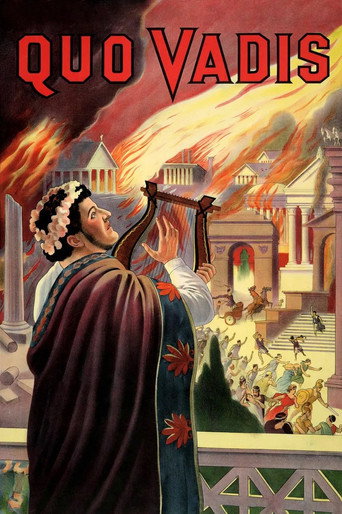
Quo Vadis? (1913)
During the latter years of the reign of the tyrannical Roman emperor Nero, Marcus Vinicius, one of Nero's officers, falls in love with a young Christian named Lygia, attempting to enslave her. Lygia's protector, the noble and burly Ursus, works to save her from Vinicius' clutches. Pursuing Lygia, Vinicius finds himself at a catacomb prayer meeting led by the apostle Peter and finds his conscience stirring-- just as Nero orders Rome burned. A landmark in epic film, Enrico Guazzoni’s grand-scale masterpiece laid the foundations for what colossal Italian spectacles would become. The film had tremendous influence on Giovanni Pastrone’s Cabiria (1914) and D.W. Griffith’s Intolerance (1916).
- Date of release
- 1913-03-01
- TMDB
- 5.7 / 10 (24)
- Runtime
- 1h 34m
- Genres
- Drama, History
- Director
- Enrico Guazzoni
Casting
- Amleto Novelli — Vinicius
- Gustavo Serena — Petronius
- Bruto Castellani — Ursus
- Amelia Cattaneo — Eunice
- Carlo Cattaneo — Nero
- Lea Giunchi — Lygia
- Augusto Mastripietri — Chino
- Cesare Moltini — Tigellinus
- Olga Brandini — Poppaea
- Ignazio Lupi — Aulus
- Giovanni Gizzi — Saint Peter
- Lia Orlandini
Interesting facts
- Based on: Quo Vadis
Quo Vadis is an Italian film directed by Enrico Guazzoni for Cines in 1913, based on the 1896 novel of the same name written by Henryk Sienkiewicz. It was one of the first blockbusters in the history of cinema, with 5,000 extras, lavish sets, and a lengthy running time of two hours, setting the standard for "superspectacles" for decades to come.
Read on Wikipedia · Text from Wikipedia, CC BY-SA 4.0. Data from Wikidata.
Recommended
- Paul, Apostle of Christ 2018 · ★ 7.6
- The Sign of the Cross 1932 · ★ 6.4
- Barabbas 1961 · ★ 6.9
- Brother Sun, Sister Moon 1972 · ★ 7.1
- King of Kings 1961 · ★ 7.2
- Esterno Notte - Prima Parte 2022 · ★ 7.8
- Karol: A Man Who Became Pope 2005 · ★ 7.0
- The Robe 1953 · ★ 6.8
- Vincere 2009 · ★ 6.7
- The Book of Daniel 2013 · ★ 7.0
- Esterno Notte - Seconda Parte 2022 · ★ 7.9
- Fuori 2025 · ★ 6.4