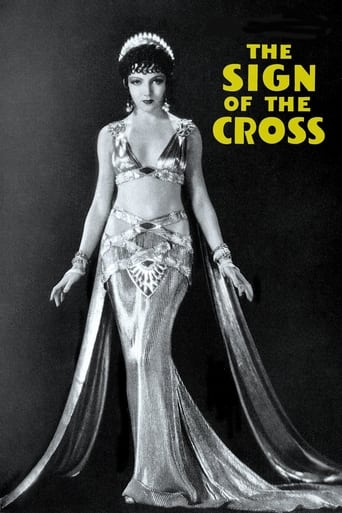
The Sign of the Cross (1932)
A picture which will proudly lead all the entertainments the world has ever seen
A Roman soldier becomes torn between his love for a Christian woman and his loyalty to Emperor Nero.
- Date of release
- 1932-12-13
- TMDB
- 6.5 / 10 (57)
- Runtime
- 2h 6m
- Genres
- Drama, History
- Director
- Cecil B. DeMille
Casting
- Fredric March — Marcus Superbus - Prefect of Rome
- Elissa Landi — Mercia
- Claudette Colbert — Empress Poppaea
- Charles Laughton — Emperor Nero Claudius Caesar
- Ian Keith — Tigellinus
- Arthur Hohl — Titus
- Harry Beresford — Favius Fontelas
- Tommy Conlon — Stephan
- Ferdinand Gottschalk — Glabrio
- Vivian Tobin — Dacia
- William V. Mong — Licinius
- Joyzelle Joyner — Ancaria
Interesting facts
- Awards: 0 · Nominations: 1
The Sign of the Cross is a 1932 American pre-Code epic historical drama film produced and directed by Cecil B. DeMille, and released by Paramount Pictures. Based on the original 1895 play by English playwright Wilson Barrett, the screenplay was written by Waldemar Young and Sidney Buchman. It stars Fredric March, Elissa Landi, Claudette Colbert, and Charles Laughton, with Ian Keith and Arthur Hohl.
Production
In 1931, when his three-picture contract with Metro-Goldwyn-Mayer ended, producer-director Cecil B. DeMille found that he could "not get a job in Hollywood." His recent film, The Squaw Man (1931), was a box-office failure due to the Great Depression, and Hollywood studio executives were showing a "profound lack of interest in the obviously washed-up deMille".
By the time DeMille returned to Famous Players–Lasky, the studio had changed its name to Paramount-Publix and had moved to a new location on Melrose Avenue. In early 1932, Neil S. McCarthy and Paramount executive B. P. Schulberg negotiated a one-picture contract for DeMille so he could make The Sign of the Cross at Paramount. Waldemar Young and Sidney Buchman worked on the script.
By June 1932, DeMille had spent 10 months preparing for the film, which he had been trying to produce for the past 12 years. With an estimated budget close to $1,000,000, DeMille expected to film it in eight to 10 weeks, beginning in July.
In London, DeMille saw Charles Laughton in the play Payment Deferred: "I knew that I had found the only man to play Nero if I ever achieved my dream of making The Sign of the Cross. […] I saw in Charles Laughton the incredibly wide range of talent which makes every role he plays seem as if it had been tailored just for him."
DeMille tried to borrow George Brent from Warner Bros. for the role of Marcus, but Brent was in demand at Warners and would not be available to play the part. DeMille then chose Fredric March on June 7, 1932.
Read on Wikipedia · Text from Wikipedia, CC BY-SA 4.0. Data from Wikidata.
Recommended
- Demetrius and the Gladiators 1954 · ★ 6.6
- The Fall of the Roman Empire 1964 · ★ 6.4
- The Robe 1953 · ★ 6.8
- Julius Caesar 1970 · ★ 5.9
- The Court-Martial of Billy Mitchell 1955 · ★ 6.8
- Ben-Hur 1959 · ★ 7.9
- The Last Rifleman 2023 · ★ 6.6
- Sergeant York 1941 · ★ 7.2
- The Book of Daniel 2013 · ★ 7.0
- Intolerance: Love's Struggle Throughout the Ages 1916 · ★ 7.1
- Julia 1977 · ★ 6.5
- Waiting for Anya 2020 · ★ 6.3