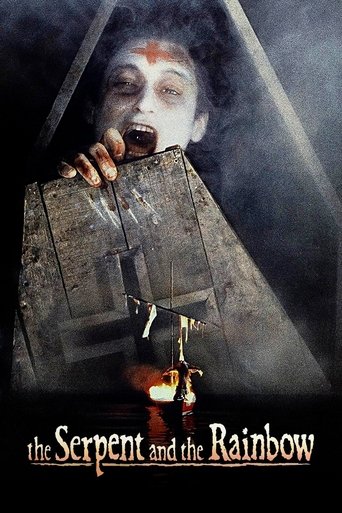
The Serpent and the Rainbow (1988)
Don't Bury Me...I'm Not Dead!
A Harvard anthropologist is sent to Haiti to retrieve a strange powder that is said to have the power to bring human beings back from the dead. In his quest to find the miracle drug, the cynical scientist enters the rarely seen netherworld of walking zombies, blood rites and ancient curses. Based on the true life experiences of Wade Davis and filmed on location in Haiti, it's a frightening excursion into black magic and the supernatural.
- Date of release
- 1988-02-05
- TMDB
- 6.4 / 10 (583)
- Runtime
- 1h 38m
- Genres
- Horror, Thriller
- Director
- Wes Craven
Casting
- Bill Pullman — Dennis Alan
- Cathy Tyson — Marielle Duchamp
- Zakes Mokae — Dargent Peytraud
- Paul Winfield — Lucien Celine
- Brent Jennings — Louis Mozart
- Conrad Roberts — Christophe
- Badja Djola — Gaston
- Theresa Merritt — Simone
- Michael Gough — Schoonbacher
- Paul Guilfoyle — Andrew Cassedy
- Dey Young — Mrs. Cassedy
- Aleta Mitchell — Celestine
Interesting facts
- Based on: The Serpent and the Rainbow
The Serpent and the Rainbow is a 1988 American horror film directed by Wes Craven and written by Richard Maxwell and Adam Rodman. It is loosely based on the non-fiction book of the same name by ethnobotanist Wade Davis, wherein Davis recounted his experiences in Haiti investigating the story of Clairvius Narcisse, who was allegedly poisoned, buried alive, and revived with an herbal brew which produced what was called a zombie. The film stars Bill Pullman, Cathy Tyson, Zakes Mokae, Paul Winfield, Brent Jennings, Michael Gough, and Paul Guilfoyle. The Serpent and the Rainbow was released in the United States by Universal Pictures on February 5, 1988.
Production
Producer Rob Cohen brought the project to Wes Craven who loved the project as he felt it was the perfect crossover piece to use his reputation as a horror director to reach a more adult audience. Wade Davis, who wrote the titular book which served as the basis for the film, served as a technical advisor during shooting.
The Serpent and the Rainbow was filmed in Boston, Massachusetts, Santo Domingo in the Dominican Republic, and in Haiti. During filming in Haiti, production was disrupted by a confrontation involving approximately 2,000 local extras who demanded higher wages. Director Wes Craven recalled fearing for the crew's safety as the dispute escalated, prompting the filmmakers to evacuate and relocate production to the neighbouring Dominican Republic.
Craven and his crew faced challenges from the shooting on location in Haiti including multiple bouts of illness from contaminated food and water, sewage leakage in local slums and cemeteries in which scenes were filmed, and the necessity of enlisting a local militia for protection. According to Craven, several villages worth of Haitians sought the crew out to work as extras on the film.
Read on Wikipedia · Text from Wikipedia, CC BY-SA 4.0. Data from Wikidata.
Recommended
- The Believers 1987 · ★ 5.9
- Books of Blood 2020 · ★ 6.2
- The Resurrected 1991 · ★ 6.2
- The Exorcist 1973 · ★ 7.8
- A Field in England 2013 · ★ 6.2
- Possessor 2020 · ★ 6.4
- Play Dead 2025 · ★ 6.3
- Nightmare Cinema 2018 · ★ 5.8
- Daddy's Head 2024 · ★ 5.9
- Messiah of Evil 1975 · ★ 6.2
- The Curse of Buckout Road 2017 · ★ 6.6
- Hellraiser 1987 · ★ 6.9