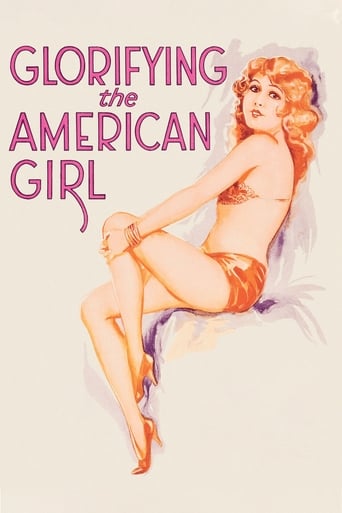
Glorifying the American Girl (1929)
With a galaxy of Broadway's famous stars- See how Broadway's darlings are glorified!
A young woman, who wants to be in the Follies, is making ends meet by working at a department store's sheet music department, where she sings the latest hits. She is accompanied on piano by her childhood boyfriend, who is in love with her, despite her single-minded interest in her career. When a vaudeville performer asks her to join him as his new partner, she sees it as an opportunity to make her dream come true. Upon arriving in New York City, our heroine finds out that her new partner is only interested in sleeping with her and makes this a condition of making her a star. Soon, however, she is discovered by a representative of Ziegfeld.
- Date of release
- 1929-12-07
- TMDB
- 5.6 / 10 (17)
- Runtime
- 1h 35m
- Genres
- Music, Comedy
- Director
- Millard Webb
Casting
- Mary Eaton — Gloria Hughes
- Eddie Cantor — Self
- Helen Morgan — Self
- Rudy Vallee — Self
- Dan Healy — Miller
- Kaye Renard — Mooney
- Edward Crandall — Buddy
- Gloria Shea — Barbara
- Sarah Edwards — Mrs. Hughes
- Noah Beery — Self (uncredited)
- Irving Berlin — Self (uncredited)
- Norman Brokenshire — Self (voice) (uncredited)
Interesting facts
Glorifying the American Girl is a 1929 American pre-Code musical comedy film produced by Florenz Ziegfeld that highlights Ziegfeld Follies performers. The last third of the film, which was filmed in early Technicolor, is basically a Follies production, with appearances by Rudy Vallee, Helen Morgan, and Eddie Cantor.
Production
This Pre-Code movie is notable for being the one of the first talkies to use the word "damn"; the word is used twice by Sarah Edwards as well as multiple times in the skit involving Eddie Cantor, Louis Sorin and Lew Hearn. Credit for being the first talkie to use the word is often erroneously given to either 1938's Pygmalion or 1939's Gone with the Wind, but the word "damn" was used twice in the film Coquette, released in April 1929 (several mont…
The revue sequence contains virtual nudity and revealing costumes. Both Paramount and EMKA failed to renew the copyright and the film is now in the public domain. EMKA's successor, Universal Studios, continues to hold the original film elements; though technically the EMKA library is part of NBC Universal Television, successor to Universal Television and MCA Television (EMKA was a subsidiary of MCA).
Read on Wikipedia · Text from Wikipedia, CC BY-SA 4.0. Data from Wikidata.
Recommended
- Babes in Arms 1939 · ★ 6.4
- Footlight Parade 1933 · ★ 6.8
- CB4 1993 · ★ 6.1
- The Cocoanuts 1929 · ★ 6.5
- Animal Crackers 1930 · ★ 6.9
- A Song Is Born 1948 · ★ 6.5
- The Big Store 1941 · ★ 6.3
- The Rutles: All You Need Is Cash 1978 · ★ 6.8
- Love Happy 1949 · ★ 5.8
- Help! 1965 · ★ 6.9
- Ziegfeld Follies 1945 · ★ 6.0
- Taking Care of Business 1990 · ★ 6.3