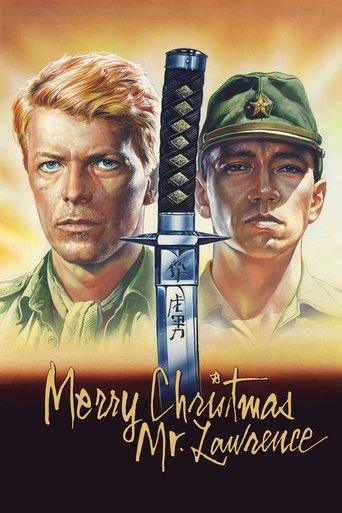
Merry Christmas, Mr. Lawrence (1983)
戦場のメリークリスマス
Java, 1942 — A clash of cultures, a test of the human spirit.
Island of Java, 1942, during World War II. British Major Jack Celliers arrives at a Japanese prison camp, run by the strict Captain Yonoi. Colonel John Lawrence, who has a profound knowledge of Japanese culture, and Sergeant Hara, brutal and simpleton, will witness the struggle of wills between two men from very different backgrounds who are tragically destined to clash.
- Date of release
- 1983-05-28
- TMDB
- 7.3 / 10 (557)
- Runtime
- 2h 4m
- Genres
- Drama, History, War
- Director
- Nagisa Ōshima
Casting
- David Bowie — Celliers
- Tom Conti — Lawrence
- Ryuichi Sakamoto — Yonoi
- Takeshi Kitano — Hara
- Jack Thompson — Hicksley
- Johnny Ohkura — Kanemoto
- Alistair Browning — De Jong
- James Malcolm — Celliers' Brother
- Chris Broun — Celliers (12 Years)
- Yuya Uchida — Commandant of Military Prison
- Ryūnosuke Kaneda — President of the Court
- Takashi Naito — Lieutenant Iwata
Interesting facts
- Based on: The Night of the New Moon
- Filmed in: Auckland and Rarotonga
Merry Christmas, Mr. Lawrence , also known as Furyo , is a 1983 war film directed by Nagisa Ōshima from a screenplay by Ōshima and Paul Mayersberg. It stars David Bowie, Tom Conti, Ryuichi Sakamoto, Takeshi Kitano, and Jack Thompson. In the film, John Lawrence (Conti), a British prisoner of war in a Japanese camp during World War II, seeks to bridge a deadly divide between a new prisoner and the camp's commander.
Production
David Bowie was cast as Jack Celliers after director Nagisa Ōshima saw him in a production of The Elephant Man on Broadway. He felt that Bowie had "an inner spirit that is indestructible". While shooting the film, Bowie was amazed that Ōshima had a two- to three-acre camp built on the remote Polynesian island of Rarotonga, but most of the camp was never shot on film. He said Ōshima "only shot little bits at the corners.
It was an early international role for Jack Thompson.
The boarding school sequence was shot on location at King's College, a private high school in Auckland, New Zealand. In a shot of two students playing billiards, another boy in the room can be seen wearing a King's blazer. Other scenes were filmed in various locations around Auckland including Auckland Railway Station.
Ōshima chose Ryuichi Sakamoto after seeing his photographs in a photo book Fifty Representative Figures of Today, and without even meeting him. The film was Sakamoto's debut soundtrack just as it was his inaugural acting role. It was also Takeshi ‘Beat’ Kitano's debut movie acting role, having only been known up to that point as a comedian on TV variety shows in Japan.
Contrary to usual cinematic practice, Ōshima shot the film without rushes and shipped the film off the island with no safety prints. "It was all going out of the camera and down to the post office and being wrapped up in brown paper and sent off to Japan", said Bowie. Ōshima's editor in Japan cut the movie into a rough print within four days of Ōshima returning to Japan.
Read on Wikipedia · Text from Wikipedia, CC BY-SA 4.0. Data from Wikidata.
Recommended
- Letters from Iwo Jima 2006 · ★ 7.5
- The Great Raid 2005 · ★ 6.6
- Escape from Sobibor 1987 · ★ 7.2
- Flags of Our Fathers 2006 · ★ 6.9
- Pork Chop Hill 1959 · ★ 6.7
- The Big Red One 1980 · ★ 6.7
- The Thin Red Line 1998 · ★ 7.4
- To End All Wars 2001 · ★ 6.4
- Walking with the Enemy 2014 · ★ 6.3
- Fires on the Plain 1959 · ★ 7.6
- Slaughterhouse-Five 1972 · ★ 6.5
- Waiting for the Barbarians 2020 · ★ 5.9