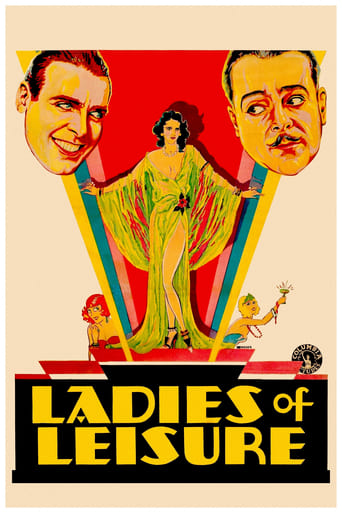
Ladies of Leisure (1930)
Zippy, daring, peppy, gay!
Kay Arnold is a gold digger who wanders from party to party with the intention of catching a rich suitor. Jerry Strong is a young man from a wealthy family who strives to succeed as an artist. What begins as a relationship of mutual convenience soon turns into something else.
- Date of release
- 1930-04-05
- TMDB
- 6.2 / 10 (31)
- Runtime
- 1h 40m
- Genres
- Drama, Romance
- Director
- Frank Capra
Casting
- Barbara Stanwyck — Kay Arnold
- Lowell Sherman — Bill Standish
- Ralph Graves — Jerry Strong
- Marie Prevost — Dot Lamarr
- Nance O'Neil — Mrs. Strong
- George Fawcett — John Strong
- Juliette Compton — Claire Collins
- Johnnie Walker — Charlie
- Jay Eaton — Balcony Party Guest (uncredited)
- Charles Butterworth — Cocktail Shaking Party Guest (uncredited)
- Willie Best — George (uncredited)
- Edith Ellison — Jerry's Housekeeper (uncredited)
Interesting facts
Ladies of Leisure is a 1930 American pre-Code romantic drama film directed by Frank Capra and starring Barbara Stanwyck, Ralph Graves, and Lowell Sherman. The screenplay by Jo Swerling is based on the 1924 play Ladies of the Evening by Milton Herbert Gropper, which ran for 159 performances on Broadway.
Production
Ladies of Leisure, which began with the working title of "Ladies of the Evening", was Frank Capra's fifth sound film, and the first project over which Columbia Pictures head Harry Cohn gave him complete creative control. Cohn assigned the director to adapt Ladies of the Evening, a melodrama David Belasco had produced on Broadway in late 1924, and after Capra completed a first draft screenplay he invited Jo Swerling – a playwright from New York wh…
Swerling initially declined because he thought it was a "putrid piece of gorgonzola", "inane, vacuous, pompous, unreal, unbelievable – and incredibly dull", but decided to work on it nonetheless. "I went to my hotel, locked myself in my room and for five days pounded out a rewrite story of the plot I'd heard, interrupting the writing only long enough for black coffee, sandwiches and brief snatches of sleep", the screenwriter later recalled.
Despite the fact her three previous films had been critical and commercial failures, Cohn was intent on casting Stanwyck as Kay, but the actress was on the verge of returning to her theatrical roots in New York City. She agreed to meet with Capra, who had another actress in mind, but the interview went badly. Stanwyck's husband, actor Frank Fay, became furious when Stanwyck returned home crying and called Capra to complain.
When filming began, Capra quickly learned Stanwyck was unlike any actress he previously had directed. In his autobiography The Name Above the Title, he recalled:
I discovered a vital technical lack – one that shook us all up: Stanwyck gave her all the first time she tried a scene ... All subsequent repetitions, in rehearsals or retakes, were pale copies of her original performance. This was a new phenomenon – and a new challenge, not only to me, but to the actors and the crews. I had to rehearse the cast without her. The actors grumbled. Not fair to them, they said.
Read on Wikipedia · Text from Wikipedia, CC BY-SA 4.0. Data from Wikidata.
Recommended
- Kitty Foyle 1940 · ★ 6.6
- Ziegfeld Girl 1941 · ★ 6.6
- Nine 1/2 Weeks 1986 · ★ 6.1
- Newness 2017 · ★ 6.1
- The Man from Elysian Fields 2001 · ★ 5.9
- London 2005 · ★ 6.0
- Anna Christie 1930 · ★ 6.0
- Save the Last Dance 2001 · ★ 6.6
- Hounddog 2008 · ★ 6.5
- A Woman of Paris: A Drama of Fate 1923 · ★ 6.7
- Step Up All In 2014 · ★ 6.8
- High Strung Free Dance 2018 · ★ 7.3