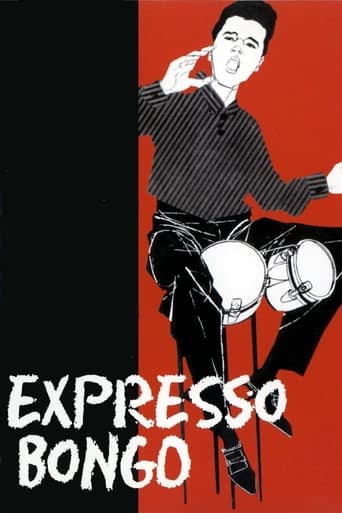
Expresso Bongo (1959)
Laurence Harvey in an outstanding and different motion picture that takes you into a world of burlesque houses .. jazz dens ... and flesh-and-blood people!
A seedy London promoter turns a naive, working-class teenager into a pop singing sensation.
Casting
- Laurence Harvey — Johnny Jackson
- Sylvia Syms — Maisie King
- Yolande Donlan — Dixie Collins
- Cliff Richard — Bert Rudge / Bongo Herbert
- Meier Tzelniker — Mayer
- Ambrosine Phillpotts — Lady Rosemary
- Gilbert Harding — Self
- Hermione Baddeley — Penelope
- Eric Pohlmann — Leon
- Reginald Beckwith — Rev. Tobias Craven
- Wilfrid Lawson — Mr Rudge
- Avis Bunnage — Mrs Rudge
Interesting facts
- Based on: Expresso Bongo
Expresso Bongo is a 1959 British drama musical film directed by Val Guest, shot in uncredited black & white Dyaliscope and starring Laurence Harvey, Cliff Richard, and Yolande Donlan. It was written by Wolf Mankowitz adapted from the stage musical of the same name by Julian More, which was first produced at the Saville Theatre, London, on 23 April 1958.
Production
The film was made at Shepperton Studios, near London. Some scenes were filmed on location, in London's Soho district. The University of London website for December, 2015, states that 32, Hanway Street, London, was also used for some of the film's scenes. Formerly 'Dicken's Chop House', about 1955 it had become 'The 'Chiquito Club' and espresso coffee bar. Its first proprietor, K. D.
Director Val Guest engaged Kenneth MacMillan to choreograph the strip-club dancers who appear in the film. Struggling to get them to dance and sing to playback at the same time, MacMillan complained, "It's the simplest routine. They may have looks, legs and tits, but they have no co-ordination."
At first, Laurence Harvey was undecided on the kind of accent he would give his character, so Guest told him he was "part Soho, part Jewish, and part middle-class" and that it might be an idea to model him on the writer Wolf Mankowitz. Harvey arranged a couple of lunches with the unsuspecting Mankowitz to study the writer at close hand, so the character Johnny Jackson in the film sounds something like the writer of the film.
Harvey's character sports a melange of accents including his own South African. Wolf Mankowitz appears in the film's opening credit sequence, wearing a sandwich-board bearing his writer credit.
This was the second screen appearance for Cliff Richard and the Shadows in 1959, the first being Serious Charge.
Read on Wikipedia · Text from Wikipedia, CC BY-SA 4.0. Data from Wikidata.
Recommended
- The Big Store 1941 · ★ 6.3
- A Hard Day's Night 1964 · ★ 7.3
- Footlight Parade 1933 · ★ 6.8
- A Song Is Born 1948 · ★ 6.5
- Love Happy 1949 · ★ 5.8
- Babes in Arms 1939 · ★ 6.4
- The Girl Can't Help It 1956 · ★ 6.3
- The Rocker 2008 · ★ 6.1
- I Wanna Hold Your Hand 1978 · ★ 6.3
- Ziggy Stardust and the Spiders from Mars 1983 · ★ 7.3
- The Cocoanuts 1929 · ★ 6.5
- Jesus Christ Superstar - Live Arena Tour 2012 · ★ 7.3