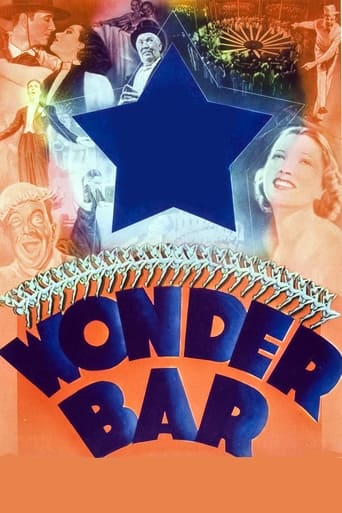
Wonder Bar (1934)
Warner Bros.' Wonder Show of the Century!
Harry and Inez are a dance team at the Wonder Bar. Inez loves Harry, but he is in love with Liane, the wife of a wealthy business man. Al Wonder and the conductor/singer Tommy are in love with Inez. When Inez finds out that Harry wants to leave Paris and is going to the USA with Liane, she kills him.
- Date of release
- 1934-03-31
- TMDB
- 6.0 / 10 (22)
- Runtime
- 1h 24m
- Genres
- Crime, Drama, Music, Romance
- Director
- Lloyd Bacon
Casting
- Al Jolson — Al Wonder
- Kay Francis — Liane Renaud
- Dolores del Río — Inez
- Ricardo Cortez — Harry
- Dick Powell — Tommy
- Guy Kibbee — Henry Simpson
- Ruth Donnelly — Emma Simpson
- Hugh Herbert — Corey Pratt
- Louise Fazenda — Pansy Pratt
- Hal Le Roy — Himself
- Fifi D'Orsay — Mitzi
- Merna Kennedy — Claire
Interesting facts
Wonder Bar is a 1934 American pre-Code musical drama film directed by Lloyd Bacon, with musical numbers choreographed and directed by Busby Berkeley. It is an adaptation of a Broadway musical of the same name that Al Jolson had starred in.
Background and production
The film is based on a German play, Die Wunderbar, written by Géza Herczeg, Robert Katscher and Karl Farkas. The American broadway play, which Jolson starred in, was originally owned by Joseph M. Schenck, who sold it to Jack Warner for the film adaptation. Jolson said at the time that this movie would be his last, as he could make more money on the radio. He claimed that "playing in this picture" cost him a $100,000 radio contract.
When Warner Bros. announced the film, some of the potential stars listed to appear in the project included Joan Blondell, Adolphe Menjou, Aline MacMahon, Bette Davis, Glenda Farrell, Pat O'Brien, Lyle Talbot, Claire Dodd, Warren William and Allen Jenkins, alongside Jolson, Davis, Powell and Kibbee.
A huge indoor set, that covered an area equal to two city blocks, had to be constructed to house Busby Berkeley's elaborate chorus scenes. The construction crew included iron-workers, who built an iron track near the roof of the soundstage to carry the derricks, machinery, camera, and sound equipment, in order for Berkeley to make the "top shots." The set also required a massive amount of lighting that would have lit up a city of 20,000 people.
Berkeley recalls that for the musical number "Don't Say Goodnight", the construction crew had to build sixty tall white movable columns, that moved against a black background; the columns were on separate tracks, independent of each other and all controlled electrically.
Berkeley said there was skepticism from the studio, because they thought with all the mirrors, the camera would be seen. He says he figured out how not for the cameras to be seen by using eight little makeup compacts, and discovered there was a way of moving at the center of the mirrors without being reflected.Berkeley experimented with a pencil that had a small strip of white tape on it.
Read on Wikipedia · Text from Wikipedia, CC BY-SA 4.0. Data from Wikidata.
Recommended
- The Wild One 1953 · ★ 6.5
- Supercross 2005 · ★ 6.3
- Fallen Angel 1945 · ★ 6.6
- They Live by Night 1949 · ★ 6.8
- Edge of the City 1957 · ★ 7.1
- Absence of Malice 1981 · ★ 6.6
- The Young Savages 1961 · ★ 6.5
- Manhattan Melodrama 1934 · ★ 7.0
- They Won't Believe Me 1947 · ★ 6.6
- Each Dawn I Die 1939 · ★ 6.9
- The Locket 1946 · ★ 6.3
- Witness to Murder 1954 · ★ 6.3