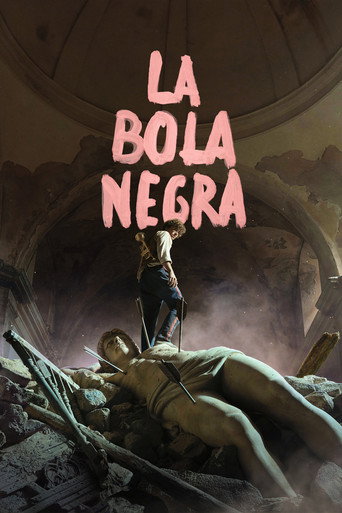
LA BOLA NEGRA (2026)
La bola negra
Love leaves a legacy.
The intertwined lives of three men in three different eras, three lives intimately linked by sexuality and desire, pain, and legacy.
- Date of release
- 2026-09-25
- TMDB
- 7.9 / 10 (270)
- Runtime
- 2h 39m
- Genres
- Drama, War
- Director
- Javier Ambrossi, Javier Calvo
Casting
- Guitarricadelafuente — Sebastián
- Miguel Bernardeau — Rafael
- Carlos González — Alberto
- Milo Quifes — Carlos
- Lola Dueñas — Teresa
- Penélope Cruz — Nené Romero
- Glenn Close — Isabelle Durand
- Julio Torres — Juan Pablo
- Yenesi — Goyita
- Lorenzo Zurzolo — Riccardo
- Antonio de la Torre — Vicente (El padre de Carlos)
- María Morales — La madre
Interesting facts
- Budget: €15M
- Based on: La bola negra (play) and La piedra oscura
- Filmed in: Castil de Carrias
- Awards: 1 · Nominations: 0. Including: Cannes Best Director Award
La bola negra, also known as The Black Ball, is a 2026 drama film directed by Javier Calvo and Javier Ambrossi, from a screenplay they co-wrote with Alberto Conejero. A queer epic inspired by the incomplete work by Federico García Lorca and Conejero's play La piedra oscura, the story hops between 1932, 1937, and 2017 to explore the connections between three gay men and Lorca's body of work. It stars Guitarricadelafuente, Miguel Bernardeau, Carlos González, Milo Quifes, Lola Dueñas, Penélope Cruz, and Glenn Close.
Production
The plot is inspired by La bola negra, an incomplete work by Federico García Lorca of which 4 pages are preserved, with the title ('the black ball') alluding to the form of rejection to a young gay man when attempting to join a social club in Granada.
Main cast members Guitarricadelafuente (in his acting debut), Carlos González, Miguel Bernardeau, Lola Dueñas, and Penélope Cruz were announced by Los Javis during the 2025 Cannes Film Festival. Ambrossi retrospectively recalled that he envisioned Héctor Bellerín as his preliminary choice for Bernardeau's role while the project was in the earliest stages of development.
On 26 August 2025, local media reported the beginning of filming in the abandoned village of Castil de Carrias, halfway between Belorado and Briviesca. Shooting also took place in Comillas (where a man working as an extra fell down some stairs on set and eventually died), Lafuente, Granada (Iglesia de Santa Ana, Carmen de los Mártires, Albaicín), Sierra Nevada, and Sigüenza. Athens and Madrid were also shooting locations.
Cinematographer Gris Jordana shot the movie on 35mm film. She used two Arricam LT cameras and Panavision Primo lenses. She explained that it was decided "not to make any distinctions regarding processing, color correction, or exposure across the three storylines", choosing instead to differentiate the periods through "audiovisual language, mise-en-scène, and camera movement".
Roger Bellés, a recurring collaborator with Los Javis since Holy Camp!, was the art director. Prior to seeing the result in scene, he was worried about criticism for the colossal size of the statue of Saint Sebastian that Sebastián climbs up in the film. While looking for locations to stand in for Nené's theatre, the crew found a venue in Sigüenza that had been closed for fifty years that was subsequently restored.
Read on Wikipedia · Text from Wikipedia, CC BY-SA 4.0. Data from Wikidata.
Recommended
- Behold a Pale Horse 1964 · ★ 6.1
- For Greater Glory: The True Story of Cristiada 2012 · ★ 7.0
- The Endless Trench 2019 · ★ 6.9
- Jacknife 1989 · ★ 6.4
- The Photographer of Mauthausen 2018 · ★ 6.9
- Firebrand 2024 · ★ 6.3
- The Last of the Mohicans 1992 · ★ 7.4
- Dance of the Forty One 2020 · ★ 7.8
- Field of Lost Shoes 2015 · ★ 6.1
- The World Will Tremble 2025 · ★ 7.5
- Schindler's List 1993 · ★ 8.6
- Braveheart 1995 · ★ 7.9