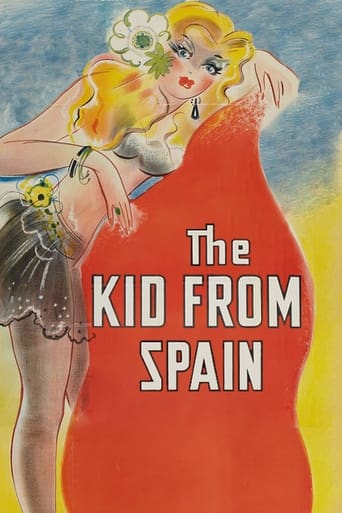
The Kid from Spain (1932)
That's a bull-fighter! That's Eddie! Way down in Mexico among the silky senoritas...with a murderous man-cow charging him and making him pay and pay!
Eddie and his Mexican friend Ricardo are expelled from college after Ricardo put Eddie in the girl's dormitory when he was drunk. Per chance Eddie gets mixed up in a bank robbery and is forced to drive the robbers to safety. To get rid of him they force him to leave the USA for Mexico, but a cop is following him. Eddie meets Ricardo there, Ricardo helps him avoid being arrested by the cop when he introduces Eddie as the great Spanish bullfighter Don Sebastian II. The problem is, the cop is still curious and has tickets for the bullfight. Eddie's situation becomes more critical, when he tries to help Ricardo to win the girl he loves, but she's engaged to a "real" Mexican, who is, unknown to her father, involved in illegal business. While trying to avoid all this trouble, Eddie himself falls in love with his friend's girl friend's sister Rosalie, who also want to see the great Don Sebastian II to kill the bull in the arena.
- Date of release
- 1932-11-17
- TMDB
- 6.5 / 10 (11)
- Runtime
- 1h 36m
- Genres
- Comedy, Music
- Director
- Leo McCarey
Casting
- Eddie Cantor — Eddie Williams
- Lyda Roberti — Rosalie
- Robert Young — Ricardo
- Ruth Hall — Anita Gomez
- John Miljan — Pancho
- Noah Beery — Alonzo Gomez
- J. Carrol Naish — Pedro
- Robert Emmett O'Connor — Detective Crawford
- Stanley Fields — Jose
- Paul Porcasi — Gonzales
- Sidney Franklin — Himself - American Matador
- Jean Allen — Goldwyn Girl (uncredited)
Interesting facts
The Kid from Spain is a 1932 American pre-Code black-and-white musical comedy film directed by Leo McCarey. Harry Ruby and Bert Kalmar composed the songs, and Busby Berkeley is credited with creating and directing the film's musical scenes. It was Jane Wyman's film debut.
Production
A high-production feature, The Kid From Spain was provided a million-dollar budget by producer Samuel Goldwyn and engaged some of the finest artistic and technical talent available in Hollywood during the early 1930s. Eddie Cantor was ranked among the top box office stars in the US in 1933: in overseas popularity he out-performed Greta Garbo and Marlene Dietrich.
Goldwyn, a notoriously "autocratic" producer, attempted to suppress any revisions to the story or script, treating director McCarey "brusquely" during filming. Cantor, in his 1957 autobiography Take My Life, recalled how he and McCarey circumvented Goldwyn: "One afternoon we got to a scene that didn't play funny." Feigning illness, Cantor left the studio and absconded for the weekend to McCarey's beach house in Santa Barbara.
The cost of the film was reported by Variety at $900,000 however, their review noted that it was said that the production budget had reached $1 million.
Cantor was due to share in the gross of the film if the gross rental exceeded $600,000, despite the film's cost being higher.
Read on Wikipedia · Text from Wikipedia, CC BY-SA 4.0. Data from Wikidata.
Recommended
- Footlight Parade 1933 · ★ 6.8
- A Day at the Races 1937 · ★ 7.1
- Love Happy 1949 · ★ 5.8
- Beau Hunks 1931 · ★ 6.8
- Babes in Arms 1939 · ★ 6.4
- A Song Is Born 1948 · ★ 6.5
- The Big Store 1941 · ★ 6.3
- Wayne's World 1992 · ★ 6.7
- Airborne 1993 · ★ 6.1
- Sneakerella 2022 · ★ 5.9
- Gabriel Iglesias: Hot and Fluffy 2007 · ★ 7.6
- Pepe 1960 · ★ 6.4