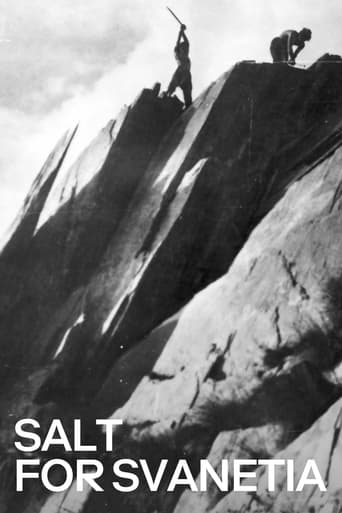
Salt for Svanetia (1930)
ჯიმ შვანთე
An ethnographic treasure that documents with visual bravado the harsh conditions of life in the isolated mountain village of Ushkul.
- Date of release
- 1930-05-24
- TMDB
- 6.8 / 10 (31)
- Runtime
- 1h 3m
- Genres
- Documentary
- Director
- Mikhail Kalatozov
Interesting facts
Salt for Svanetia is a 1930 Soviet silent documentary film directed by Mikhail Kalatozov. As one of the earliest ethnographic films, it documents the life of the Svan people in the isolated mountain village of Ushguli in Svanetia, in the northwestern part of the Georgian Soviet Republic.
Production
Svanetia was an underdeveloped region, and thus Soviet planners tried to make it a showcase of Soviet modernization during the first five-year plan between 1928 and 1932. During this time roads were built, an air service was established and industries such as mining and lumbering were developed. It was against this background of Svanetia as a showcase of Soviet modernization that Salt for Svanetia was produced.
Inspired by a tour of the Caucasus, the writer and journalist Sergei Tretyakov wrote a newspaper article that gave Kalatozov the idea for the film. Tretyakov then wrote a script for Kalatozov, and shooting began in the village of Ushguli in Upper Svanetia. Originally the film was planned to be a fictional feature film, but ultimately Viktor Shklovsky edited the footage Kalatozov had shot in Svanetia into a documentary film.
Read on Wikipedia · Text from Wikipedia, CC BY-SA 4.0. Data from Wikidata.
Recommended
- Fuck 2006 · ★ 6.4
- Come See Me in the Good Light 2025 · ★ 7.1
- In the Realms of the Unreal 2004 · ★ 7.2
- The Battle of San Pietro 1945 · ★ 6.1
- To Kill a Tiger 2023 · ★ 7.6
- Sherman's March 1986 · ★ 6.3
- My Mom Jayne 2025 · ★ 7.9
- McQueen 2018 · ★ 7.4
- Elstree 1976 2015 · ★ 6.2
- Burma VJ: Reporting from a Closed Country 2008 · ★ 7.3
- Directed by John Ford 1971 · ★ 7.0
- As I Was Moving Ahead Occasionally I Saw Brief Glimpses of Beauty 2000 · ★ 7.8