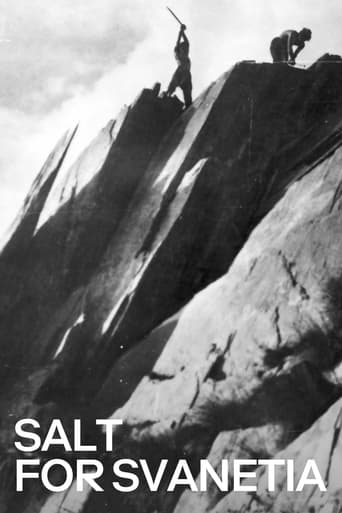
Sal para Svanetia (1930)
ჯიმ შვანთე
Documental sobre las duras condiciones de vida de los habitantes de la región de Svanetia.
"Sal para Svanetia" no se parece en nada a los documentales actuales y, por tanto, la historia debe seguir una estructura y un patrón diferentes. El tema se transmite a través de intertítulos y de las tomas cinéticas y de la edición utilizada para mostrar la urgencia y el peligro dentro de la película. Con el uso de técnicas de montaje, con frecuencia se unen tomas no relacionadas para agregar a la historia y apoyar la tesis. El montaje conduce a la audiencia a través de los rituales y hábitos desconocidos de la ciudad, como el esquilado de ovejas, la confección de sombreros y los ritos funerarios. La forma en que está formateada y cortada hace que la película se perciba tanto educativa como subjetivamente, en especial con el mensaje de cómo se puede ayudar a la lucha de esta aldea con la sal para sobrevivir. En general está bellamente filmada y la elección de las tomas ayuda a crear y transmitir la idea de un pueblo desesperado y aislado que sólo podría salvarse con un nuevo gobierno.
- Fecha de estreno
- 1930-05-24
- TMDB
- 6.8 / 10 (31)
- Duración
- 1 h 3 min
- Géneros
- Documental
- Director
- Mijaíl Kalatózov
Curiosidades
Salt for Svanetia is a 1930 Soviet silent documentary film directed by Mikhail Kalatozov. As one of the earliest ethnographic films, it documents the life of the Svan people in the isolated mountain village of Ushguli in Svanetia, in the northwestern part of the Georgian Soviet Republic.
Production
Svanetia was an underdeveloped region, and thus Soviet planners tried to make it a showcase of Soviet modernization during the first five-year plan between 1928 and 1932. During this time roads were built, an air service was established and industries such as mining and lumbering were developed. It was against this background of Svanetia as a showcase of Soviet modernization that Salt for Svanetia was produced.
Inspired by a tour of the Caucasus, the writer and journalist Sergei Tretyakov wrote a newspaper article that gave Kalatozov the idea for the film. Tretyakov then wrote a script for Kalatozov, and shooting began in the village of Ushguli in Upper Svanetia. Originally the film was planned to be a fictional feature film, but ultimately Viktor Shklovsky edited the footage Kalatozov had shot in Svanetia into a documentary film.
Leer en Wikipedia · Texto de Wikipedia, CC BY-SA 4.0. Datos de Wikidata.
Recomendadas
- Fuck 2006 · ★ 6.4
- Come See Me in the Good Light 2025 · ★ 7.1
- In the Realms of the Unreal 2004 · ★ 7.2
- The Battle of San Pietro 1945 · ★ 6.1
- Matar a un tigre 2023 · ★ 7.6
- La marcha de Sherman 1986 · ★ 6.3
- Mi mama Jayne: una película de Mariska Hargitay 2025 · ★ 8.0
- McQueen 2018 · ★ 7.4
- Elstree 1976 2015 · ★ 6.2
- Birmania VJ: Informando desde un país cerrado 2008 · ★ 7.3
- Dirigida por John Ford 1971 · ★ 7.0
- En el camino, de cuando en cuando, vislumbré breves momentos de belleza 2000 · ★ 7.8