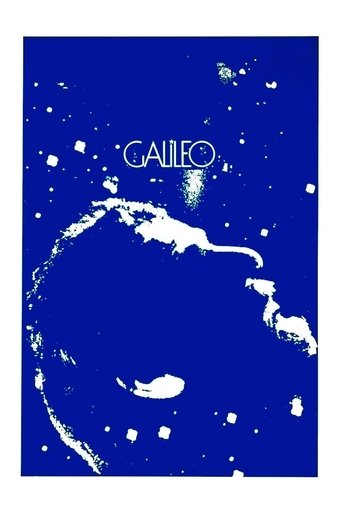
Galileo (1975)
Challenged by a new student, tutor and theorist Galileo co-opts emerging telescope technology and discovers irrefutable proof of the heretical notion that the earth is not the center of the universe. But in a rigid society ruled by an uneasy alliance of aristocracy and clergy already undermined by the Plague and the Reformation, science is a threat and enlightenment is a luxury. Faced with either death at the hands of the Inquisition or recantation to a hypocritical but all-powerful Papacy, Galileo must choose between his own life and the restless scientific curiosity that he has spurned family, friends, and wealth to pursue.
- Date of release
- 1975-01-27
- TMDB
- 6.1 / 10 (15)
- Runtime
- 2h 25m
- Genres
- Drama, History
- Director
- Joseph Losey
Casting
- Chaim Topol — Galileo Galilei
- Edward Fox — Cardinal Inquisitor
- Colin Blakely — Priuli
- Georgia Brown — Ballad Singer's Wife
- Clive Revill — Ballad Singer
- Margaret Leighton — Elderly Court Lady
- John Gielgud — The Old Cardinal
- Michael Gough — Sagredo
- Michael Lonsdale — Cardinal Barberini (later Pope Urban VIII)
- Richard O'Callaghan — Fulganzio
- Tim Woodward — Ludovico Marsili
- Judy Parfitt — Angelica Sarti
Interesting facts
Galileo is a 1975 historical biographical drama film directed and co-written by Joseph Losey, about the 16th- and 17th-century scientist Galileo Galilei, whose astronomical observations with the newly invented telescope led to a profound conflict with the Roman Catholic Church. The film stars an ensemble cast, led by Topol in the titular role, along with Georgia Brown, Edward Fox, John Gielgud, Margaret Leighton, Colin Blakely, Clive Revill, Michael Lonsdale, Patrick Magee and Tom Conti.
Production
Losey had a long relationship with Brecht that commenced in the 1930s and culminated with the 1947 stage performances of Galileo. After these, Losey mainly worked as a film director. Losey was blacklisted in the US in the early 1950s due to his political activities, which effectively ended his career in the US film industry. He emigrated to England, where he was able to re-establish his career.
The screenplay for Galileo was written by Barbara Bray and Losey. Bray had a long career as an editor, translator, and critic. She is also noted as the longtime companion and mistress of Samuel Beckett, who won the Nobel Prize in Literature in 1969. Besides Galileo, she wrote two other screenplays with Losey. Their screenplay for Galileo relies primarily on the "American" version of Brecht's play that was first performed in 1947.
For the film, Losey maintained several theatrical concepts that had been part of the 1947 theatrical production. These included the use of a trio of young boys whose songs preview parts of the plot, and also the staging of Galileo's recantation against a shadow-filled white screen (cyclorama). Losey's opening shot, an overhead view of the film sound stage, also calls attention to the theatricality of the production.
Casting for the AFT films was unusual. As described by Raymond Benson, "The talent (directors, actors, designers, technicians) was asked to work at a reduced rate or at scale. No one refused. It was for a cause they all thought was worthwhile. Lee Marvin, for example, joked that he 'lost $225,000' by starring in The Iceman Cometh (which meant his salary was $25,000—his going rate at the time was $250,000)."
Prior to casting Topol, Losey had lobbied for Rod Steiger to play the title role.
Read on Wikipedia · Text from Wikipedia, CC BY-SA 4.0. Data from Wikidata.
Recommended
- The Two Popes 2019 · ★ 7.5
- Goya's Ghosts 2006 · ★ 6.6
- Paul, Apostle of Christ 2018 · ★ 7.6
- The Scarlet and the Black 1983 · ★ 7.1
- Barabbas 1961 · ★ 6.9
- Julius Caesar 1953 · ★ 7.1
- Munich - The Edge of War 2021 · ★ 6.9
- Eight Men Out 1988 · ★ 6.8
- Risen 2016 · ★ 6.3
- The Immortal Life of Henrietta Lacks 2017 · ★ 6.3
- Come Sunday 2018 · ★ 5.8
- Breach 2007 · ★ 6.6