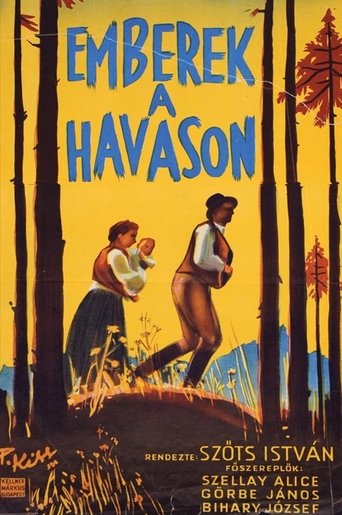
People of the Mountains (1942)
Emberek a havason
A simple, religious Hungarian woodcutter lives with his wife and boy child with a small community of squatters among the peaceful mountains of Transylvania until a lumber company claims their land and forces them all to become company workers or else leave the land. This 1942 Hungarian film takes a detailed and unflinching look at the hardships of mountain living, and the realistic approach proved influential to the Neorealist movement in Italian cinema. Hungarian master director Istvan Szots won the Biennale Cup at the Venice Film Festival for his auspicious debut, but the film was banned by the Nazis as "too Catholic" and not publicly exhibited until after World War II.
- Date of release
- 1942-02-28
- TMDB
- 7.6 / 10 (13)
- Runtime
- 1h 28m
- Genres
- Drama
- Director
- István Szőts
Casting
- János Görbe — Gergely Csutak
- Alice Szellay — Anna Csutak
- Péterke Ferency — Gergö Csutak, their son
- József Bihari — Márton Üdö , Gergo's godfather
- Lajos Gárday — Ádám Ülkei
- Oszkár Borovszky — manager
- Lenke Egyed — maid
- Imre Toronyi — György Bende, doctor
- György Kürthy — György Bende
- Elemér Baló — woodcutter
- János Pásztor — woodcutter
- Jenö Danis — woodcutter
Interesting facts
People of the Mountains is a 1942 Hungarian drama film directed by István Szőts and starring Alice Szellay, János Görbe, Péterke Ferency. The film is set in the Székely woodcutting community of Transylvania. The film's plot was based on a series of short stories by József Nyírő. The film was exhibited at the 1942 Venice Film Festival, where it was widely praised. The film's style has been suggested as an influence on the emerging Italian neorealism. It was not granted an exhibition certificate in Nazi Germany because Joseph Goebbels considered it "too Catholic". The film was chosen to be part of the New Budapest Twelve, a list of Hungarian films considered the best in 2000.
Production
The film was shot on location in Northern Transylvania, which had been ceded back to the Kingdom of Hungary by the Kingdom of Romania according to the Second Vienna Award in 1940, before Hungary and Romania entered the Second World War. Interior scenes were filmed at the Hunnia Film Studio in Budapest. The film was originally conceived as a short film, but the studios' bosses agreed to make it a feature film as long as costs could be kept low.
Read on Wikipedia · Text from Wikipedia, CC BY-SA 4.0. Data from Wikidata.
Recommended
- Satantango 1994 · ★ 8.1
- The Young One 1960 · ★ 7.0
- Three Christs 2017 · ★ 6.7
- Holy Lands 2019 · ★ 6.1
- White God 2014 · ★ 6.6
- My Neighbor Adolf 2022 · ★ 6.6
- Hardball 2001 · ★ 6.5
- Preparations to Be Together for an Unknown Period of Time 2020 · ★ 5.9
- The Kindness of Strangers 2019 · ★ 6.4
- Farming 2018 · ★ 6.2
- Hands of Stone 2016 · ★ 6.6
- Bastard Out of Carolina 1996 · ★ 7.1