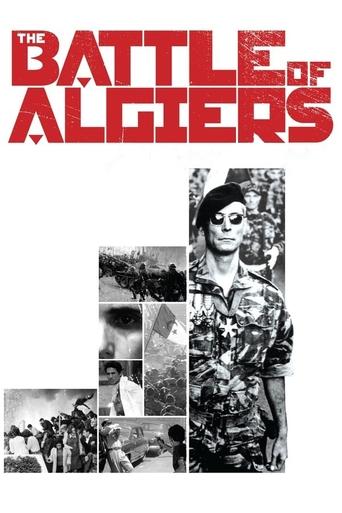
The Battle of Algiers (1966)
La battaglia di Algeri
The Revolt that Stirred the World!
Former petty criminal Ali la Pointe becomes a commander of the Algerian Front de Liberation Nationale, directing a guerilla insurgency against the colonial French occupation. Paratrooper commander Colonel Phillippe Mathieu, a veteran of World War II and the First Indochina War, is sent to Algeria to reinforce efforts to squelch the uprisings.
- Date of release
- 1966-09-08
- TMDB
- 7.9 / 10 (953)
- Runtime
- 2h 2m
- Genres
- Drama, War, History
- Director
- Gillo Pontecorvo
Casting
- Brahim Hadjadj — Ali La Pointe
- Jean Martin — Colonel Philippe Mathieu
- Yacef Saâdi — El-Hadi Jaffar
- Samia Kerbash — Fathia
- Ugo Paletti — Captain
- Fouzia El Kader — Halima
- Mohamed Ben Kassen — Petit Omar
- Si Mohamed Baghdadi — Larbi Ben M'hidi (uncredited)
- Franco Moruzzi — Mahmoud (uncredited)
- Tomasso Neri — Captain Dubois (uncredited)
- Rouiched — The Drunk Man (uncredited)
- Gene Wesson — (uncredited)
Interesting facts
- Box office: $962K
- Budget: $806.7K
- Earned 1.2× its budget
- Filmed in: Algiers
- Awards: 1 · Nominations: 4. Including: Golden Lion
The Battle of Algiers is a 1966 Italian-Algerian war film co-written and directed by Gillo Pontecorvo. It is based on action undertaken by rebels during the Algerian War (1954–1962) against the French government in North Africa, the most prominent being the eponymous Battle of Algiers, the capital of Algeria. It was shot on location in a Roberto Rossellini-inspired newsreel style: in black and white with documentary-type editing to add to its sense of historical authenticity, with mostly non-professional actors who had lived through the real battle. The film's score was composed by Pontecorvo and Ennio Morricone. It is often associated with Italian neorealist cinema.
Production and style
The Battle of Algiers was inspired by the 1962 book Souvenirs de la Bataille d'Alger, an FLN military commander's account of the campaign, by Saadi Yacef. Yacef wrote the book while he was held as a prisoner of the French, and it served to boost morale for the FLN and other militants. After independence, the French released Yacef, who became a leader in the new government. The Algerian government backed adapting Yacef's memoir as a film.
To meet the demands of film, The Battle of Algiers uses composite characters and changes the names of certain persons. For example, Colonel Mathieu is a composite of several French counterinsurgency officers, especially Jacques Massu. Yacef has said that Mathieu was based more on Marcel Bigeard, although the character is also reminiscent of Roger Trinquier.
For The Battle of Algiers, Pontecorvo and cinematographer Marcello Gatti filmed in black and white and experimented with various techniques to give the film the look of newsreel and documentary film. The effect was so convincing that American releases carried a notice that "not one foot" of newsreel was used.
Pontecorvo's use of fictional realism enables the movie "to operate along a double-bind as it consciously addresses different audiences." The film makes special use of television in order to link western audiences with images they are constantly faced with that are asserted to express the "truth".
Pontecorvo chose to cast non-professional Algerians. He chose people whom he met, picking them mainly on appearance and emotional effect (as a result, many of their lines were dubbed). The sole professional actor of the movie was Jean Martin, who played Colonel Mathieu; Martin was a French actor who had worked primarily in theatre.
Read on Wikipedia · Text from Wikipedia, CC BY-SA 4.0. Data from Wikidata.
Recommended
- Outlaws - For Greater Glory 2012 · ★ 7.0
- Field of Lost Shoes 2015 · ★ 6.1
- Inglourious Basterds 2009 · ★ 8.2
- Legionnaire 1998 · ★ 5.9
- Beasts of No Nation 2015 · ★ 7.6
- The Siege of Jadotville 2016 · ★ 7.1
- Jacknife 1989 · ★ 6.4
- Battleground 1949 · ★ 6.7
- Force 10 from Navarone 1978 · ★ 6.3
- Walking with the Enemy 2014 · ★ 6.3
- Many Wars Ago 1970 · ★ 7.3
- The Beast of War 1988 · ★ 7.1