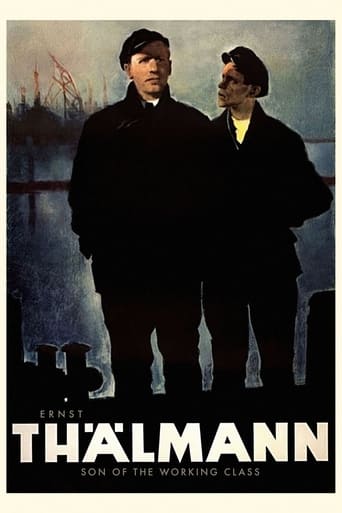
Ernst Thälmann – Son of the Working Class (1954)
Ernst Thälmann - Sohn seiner Klasse
This film is the first of a two-part historical and biographical portrait of the communist politician and anti-fascist Ernst Thälmann. In early November 1918, Ernst Thälmann is an unwilling soldier serving on the western front. As the revolutionary movement at home is threatened by the betrayal of the Social Democrats and fissures in the working class, Thälmann calls on his fellow soldiers to put down their weapons and unite with the workers in the communist struggle at home. Thälmann’s qualms about which side he is fighting on continue, but when the local police attempt to prevent a shipment of provisions and supplies from reaching the people in Petrograd, he intervenes and the ship is unloaded. With this moment of clarity, Thälmann continues to follow his political convictions and joins the workers at the Hamburg uprising in October 1923.
- Date of release
- 1954-03-09
- TMDB
- 5.7 / 10 (10)
- Runtime
- 2h 4m
- Genres
- History, Drama
- Director
- Kurt Maetzig
- Collection
- Ernst Thälmann Collection
Casting
- Günther Simon — Ernst Thälmann
- Hans-Peter Minetti — Fiete Jansen
- Erich Franz — Arthur Vierbreiter
- Erika Dunkelmann — Martha Vierbreiter
- Johannes Arpe — Höhn
- Raimund Schelcher — Krischan Daik
- Karla Runkehl — Änne Harms
- Gerhard Bienert — Otto Kramer
- Robert Trösch — Kuddel Riemöller
- Wolf Kaiser — Major Zinker
- Werner Peters — Hauptmann Quadde
- Martin Flörchinger — Karl Liebknecht
Interesting facts
Ernst Thälmann is an East German communist propaganda film in two parts about the life of Ernst Thälmann, leader of the Communist Party of Germany during much of the Weimar Republic, directed by Kurt Maetzig and starring Günther Simon in the title role. The first part, Ernst Thälmann – Sohn seiner Klasse, was released in 1954. It was followed by the 1955 sequel. Ernst Thälmann – Führer seiner Klasse.
Production
Ernst Thälmann, the Communist Party of Germany's chief who was executed by the Nazi regime in 1944 after spending 11 years in prison, was revered as a national hero and a martyr in the nascent East Germany. Thälmann's character combined communist convictions with an uncompromising struggle against Fascism; in a broader sense, he served as part of what author Russell Lemmons referred to as East Germany's "foundation myth": the belief that the comm…
The film was conceived in 1948, after the Soviet Occupation Zone's provisional authorities and the leadership of the SED commissioned it; according to director Kurt Maetzig, "it was handed down from above". Willi Bredel and Michael Tschesno-Hell, both political functionaries, were exempted from all their other duties to concentrate on writing the script.
Bredel and Tschesno-Hell completed the first draft of the script in early 1951. The plot began with the four-year-old Ernst shoving socialist pamphlets in his trousers to hide them from the police officers who raided his father's tavern, where an illegal meeting of the SPD took place. It also featured his childhood and youth with his parents, his falling in love with the young Rosa Koch and his years as a simple worker who turned to communism.
DEFA concluded that Bredel's and Tschesno-Hell's script would require splitting the film into three parts. This was deemed too long by the committee. After a year of deliberations, most of the original screenplay was rejected. In January 1951, it was decided to have a two-part picture, the first dealing with the time from the end of World War I to 1930, and the second taking off in 1932 and continuing until the founding of the German Democratic R…
The political establishment had closely monitored the work. According to historian René Börrner, "no other film, in the years before or after, received such attention from the SED". On 21 August 1951, Walter Ulbricht sent the committee a letter in which he requested that a meeting between Thälmann and Joseph Stalin would be portrayed.
Read on Wikipedia · Text from Wikipedia, CC BY-SA 4.0. Data from Wikidata.
Recommended
- Rosa Luxemburg 1986 · ★ 6.5
- Truth & Treason 2025 · ★ 8.1
- Watch on the Rhine 1943 · ★ 6.9
- Goebbels and the Führer 2024 · ★ 6.6
- The People vs. Fritz Bauer 2015 · ★ 6.8
- Nuremberg 2025 · ★ 7.6
- The Enigma of Kaspar Hauser 1974 · ★ 7.3
- The Lives of Others 2006 · ★ 8.0
- Naked Among Wolves 2015 · ★ 7.3
- Marianne and Juliane 1981 · ★ 7.0
- Downfall 2004 · ★ 7.9
- The Last Train 2006 · ★ 7.2