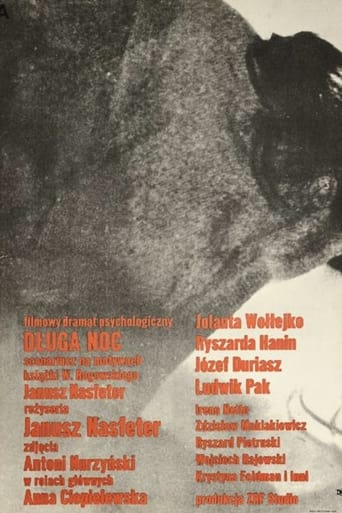
Long Night (1989)
Długa noc
The residents of an apartment complex in World War 2 Poland face a moral dilemma when they discover one of their neighbours is hiding a Jew.
- Date of release
- 1989-10-30
- Runtime
- 1h 18m
- Genres
- Drama, War
- Director
- Janusz Nasfeter
Casting
- Anna Ciepielewska — Katarzyna Katjanowa
- Ryszarda Hanin — Piekarczykowa
- Jolanta Wołłejko — Marta
- Józef Duriasz — Zygmunt Korsak
- Ludwik Pak — Józef Katjan
- Zygmunt Hobot — Jew
- Henryk Hunko — Szymański
- Zdzisław Maklakiewicz — Antoszka
- Halina Buyno-Łoza — Szymańska
- Krystyna Feldman — Woman with a Broken Watch
- Maria Górecka
- Antonina Girycz — Szymańskis' Daughter
Interesting facts
Długa noc is a Polish war film from 1967, directed by Janusz Nasfeter, based on the novel Noc by Wiesław Rogowski. The plot revolves around the dilemmas faced by the residents of a certain house in occupied Poland during World War II, where one of the inhabitants is revealed to be a collaborator with a partisan unit and a person hiding a Jew. Długa noc was one of the earliest "shelf films" – movies whose distribution was prevented by censorship during the communist regime. Created in an atmosphere of anti-Semitic sentiments, Nasfeter's film was not allowed to be shown until 1989.
Production
In 1961, Wydawnictwo Lubelskie published Wiesław Rogowski's debut novel Noc, set in Lubelszczyzna. Rogowski described anti-Semitic acts among Poles in the provinces long before the books of Jan Tomasz Gross, noting the exploitation of Jews in need of help, robbing them, and ruthlessly getting rid of the problem by denying them shelter, murdering them, or handing them over to the Germans.
Nasfeter personally wrote the screenplay based on Rogowski's book in the summer of 1966. Cautiously, he removed the subplot of the Jew Jakub’s wandering after escaping from the Lublin Ghetto, shifted the time of the action to winter, and limited it to a few hours. While the Jew was the central figure in the novel, Nasfeter made him merely a catalyst for the tumultuous events in the provincial house.
Długa noc was produced by the Studio Film Unit under the artistic direction of Aleksander Ford, at the Film Studio in Wrocław. Marceli Nowak was the film’s production manager. Cinematography was handled by Antoni Nurzyński, who primarily used close-ups of the characters' faces for dramatic effect. The location chosen for Długa noc was Wyszogród, near Warsaw. Due to weather conditions, not only the cast but also the crew members wore fur coats.
The review of Długa noc took place a few days after the outbreak of the Six-Day War, during which the Eastern Bloc countries supported the Arab aggressors against Israeli forces. The reaction of the Polish People's Republic's authorities was dictated by the Soviet Union, and anti-Semitic sentiments were stoked from the top.
Although the film was initially planned to be released, media interest in Długa noc gradually waned. It became clear that the film would never be shown during the communist era. From a list of films banned by the authorities, it was evident that Długa noc was one of the top-priority films to be banned, right after The Devil (1972) by Andrzej Żuławski and Ręce do góry (1968) by Jerzy Skolimowski.
Read on Wikipedia · Text from Wikipedia, CC BY-SA 4.0. Data from Wikidata.
Recommended
- Waiting for Anya 2020 · ★ 6.3
- Irena's Vow 2024 · ★ 7.7
- The Boy in the Woods 2023 · ★ 7.0
- Uprising 2001 · ★ 6.6
- Filip 2023 · ★ 6.9
- In Darkness 2011 · ★ 6.9
- A Generation 1955 · ★ 6.9
- The Monuments Men 2014 · ★ 6.1
- The Island on Bird Street 1997 · ★ 7.3
- Schindler's List 1993 · ★ 8.6
- Resistance 2020 · ★ 7.0
- The One That Got Away 1957 · ★ 6.8