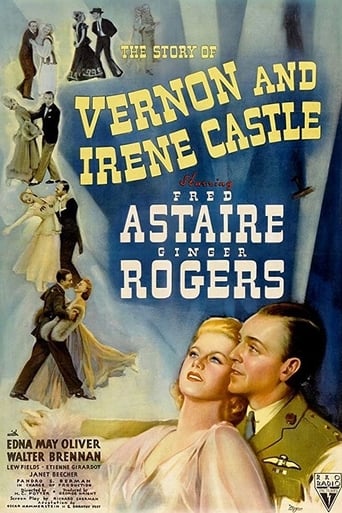
The Story of Vernon and Irene Castle (1939)
Dazzling entertainment rainbowed by memory's most haunting hit melodies!
In 1911, minor stage comic, Vernon Castle meets the stage-struck Irene Foote. A few misadventures later, they marry and then abandon comedy to attempt a dancing career together. While they're performing in Paris, an agent sees them rehearse and starts them on their brilliant career as the world's foremost ballroom dancers. However, at the height of their fame, World War I begins.
- Date of release
- 1939-03-29
- TMDB
- 7.0 / 10 (44)
- Runtime
- 1h 33m
- Genres
- Music, Romance
- Director
- H. C. Potter
Casting
- Fred Astaire — Vernon Castle
- Ginger Rogers — Irene Castle
- Edna May Oliver — Maggie Sutton
- Walter Brennan — Walter
- Lew Fields — Lew Fields
- Etienne Girardot — Papa Aubel
- Janet Beecher — Mrs. Foote
- Rolfe Sedan — Emile Aubel
- Leonid Kinskey — Artist
- Robert Strange — Dr. Foote
- Douglas Walton — Student Pilot
- Clarence Derwent — Papa Louis
Interesting facts
The Story of Vernon and Irene Castle is a 1939 American biographical musical comedy film directed by H.C. Potter. The film stars Fred Astaire, Ginger Rogers, Edna May Oliver, and Walter Brennan. The film is based on the stories My Husband and My Memories of Vernon Castle, by Irene Castle. The movie was adapted by Oscar Hammerstein II, Dorothy Yost and Richard Sherman. It was Astaire and Rogers' ninth and last film together with RKO. Their final pairing was The Barkleys of Broadway (1949) at MGM.
Production
Irene Castle acted as advisor to this film, and constantly disagreed with the director as to details of costuming and liberties taken. When informed that white actor Walter Brennan was to play the part of faithful servant Walter, she was dumbfounded: the real Walter was black.
The film marks several "firsts": the characters in it are more realistic than usual in an Astaire-Rogers film, there is none of the usual "screwball comedy" relief provided by such actors as Edward Everett Horton, Victor Moore, or Helen Broderick, it is the only Astaire-Rogers musical biography, the only one on which Oscar Hammerstein II worked, the only one of their musicals with a tragic ending, and the only one in which Astaire's character die…
Astaire and Rogers dance to the Cecil Macklin song Too Much Mustard.
Read on Wikipedia · Text from Wikipedia, CC BY-SA 4.0. Data from Wikidata.
Recommended
- Easter Parade 1948 · ★ 7.1
- Oklahoma! 1955 · ★ 6.6
- Salsa 1988 · ★ 6.9
- Roustabout 1964 · ★ 6.0
- Aladdin 2019 · ★ 7.1
- Camelot 1967 · ★ 6.2
- Love at First Dance 2018 · ★ 6.0
- The Tourist 2010 · ★ 6.2
- A Brush with Love 2019 · ★ 5.9
- Love Takes Flight 2019 · ★ 7.3
- Thumbelina 1994 · ★ 6.5
- Merry Matrimony 2015 · ★ 5.8