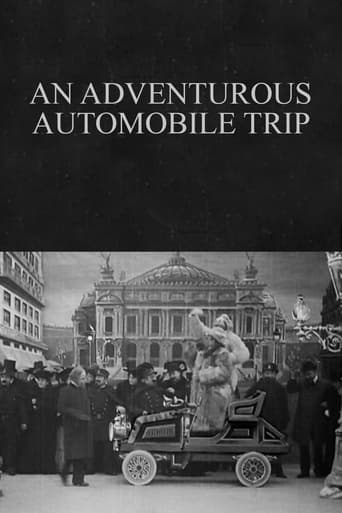
An Adventurous Automobile Trip (1905)
Le Raid Paris-Monte Carlo en deux heures
A man needs to get to Monte Carlo from Paris, but finds out that a train will take 17 hours to get there. He decides to go with a man with a special car, who claims that he can get there in just two hours. Complications ensue.
- Date of release
- 1905-08-19
- TMDB
- 5.8 / 10 (22)
- Runtime
- 10m
- Genres
- Adventure
- Director
- Georges Méliès
Casting
Interesting facts
An Adventurous Automobile Trip is a 1904 French silent comic trick film directed by Georges Méliès. The film, a spoof of the devil-may-care motoring exploits of King Leopold II of Belgium, features the King engaging in a manic, implausibly fast automobile ride from Paris to Monte Carlo. The singer-comedian Harry Fragson stars as the King, supported by a large cast of stage performers from the Folies Bergère cabaret and other venues, with two cameo appearances from Méliès himself.
Production
For the 1904 Folies Bergère cabaret revue, the director Victor de Cottens approached Méliès—then at the height of his fame as a filmmaker—with the idea of combining theatre and cinema by presenting a short film as one of the fourteen segments of the stage production. The two directors worked out a scenario that would parody the motoring adventures of King Leopold II of Belgium, who was famous for driving, and often crashing, fast cars.
Méliès drew the cast of the film from various sources. Harry Fragson, a London-born singer and comedian who was one of the stars of the Folies Bergère at the time, played the lead role of King Leopold. Louis Maurel, a Paris singer and comedian who had worked with Fragson in the 1903 Folies Bergère revue, was the chauffeur.
In addition to the parody of King Leopold II, Méliès's scenario for the film features another topical element: the scene with the tar wagon is based on the experiments of Ernest Guglielminetti, who spread tar over a small part of the gravel road to Monaco. This experiment, widely reported by the press, successfully eliminated the dust clouds kicked up by cars on gravel and sand roads.
The film's special effects were created using stage machinery, miniature models, pyrotechnics, and the editing technique known as the substitution splice. Long shots showing the car were filmed with a miniature car and a landscape rolling past it, creating a multiplane effect. Most scenes, including the detailed and faithful recreation of the Place de l'Opéra outside the Opera House, were painted studio sets, as was Méliès's custom.
Read on Wikipedia · Text from Wikipedia, CC BY-SA 4.0. Data from Wikidata.
Recommended
- The Black Pirate 1926 · ★ 6.7
- The Sheik 1921 · ★ 5.9
- Scaramouche 1952 · ★ 7.0
- Ticker 2002 · ★ 6.7
- The Prince and the Pauper 1962 · ★ 7.2
- No Time for Nuts 2006 · ★ 7.4
- Peter's To-Do List 2019 · ★ 6.9
- Anastasia: Once Upon a Time 2020 · ★ 5.9
- White Fang 2: Myth of the White Wolf 1994 · ★ 6.9
- Silent 2014 · ★ 6.6
- Pirates of the Caribbean: Tales of the Code: Wedlocked 2011 · ★ 6.7
- The Fantastic Flying Books of Mr. Morris Lessmore 2012 · ★ 7.5