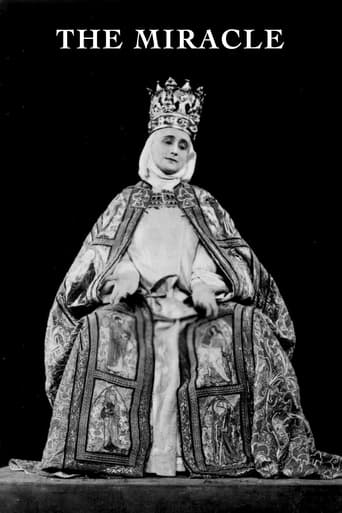
The Miracle (1912)
When a wayward nun, Megildis, deserts her convent with a knight, a statue of the Virgin Mary comes to life and takes place of Megildis, who makes her way through the world and its many vicissitudes.
- Date of release
- 1912-12-21
- TMDB
- 7.0 / 10 (3)
- Runtime
- 1h 3m
- Director
- Michel Carré
Casting
- Maria Carmi — The Madonna
- Florence Winston — Megildis, the Nun
- Douglas Payne — The Knight
- Ernst Matray — The Minstrel
Interesting facts
The Miracle is a 1912 British silent full-colour film, using a hand-coloured process similar to Pathéchrome. Produced by Joseph Menchen and directed by Michel Carré, it is among the first full-colour feature films to be made. It stars Maria Carmi, Ernst Matray, Florence Winston and Douglas Payne, and was filmed on location in Austria.
Production team
The film seems to have been the brainchild of its producer, Joseph Menchen, a London-based American inventor, film projectionist and owner of a New York theatrical lighting business who later became a literary agent for film scripts. Reports of copyright cases in the English and US courts confirm that Menchen made the film, and a review of the film's US première in New York referred to it as "the Menchen Miracle".
Menchen obtained the sole rights and film rights from Reinhardt and from Bote & Bock (Vollmöller's and Humperdinck's publishers), and had "gone to very considerable expense" (£20,000 or $50,000) "in preparing a film of the play, which he intended to produce with Mr. Walter Hyman" at the Covent Garden Opera House on 21 December." Another name (possibly a financial backer) appearing in connection with the production is that of A. D. Rosenthal.
Reinhardt seems to have been involved in some initial technical discussions about a film of The Miracle (according to a July 1912 article in The Cinema before the film had been made) although he seems to have had little to do with its actual making.
Although much of the 'direction' belongs essentially to Reinhardt (since the movie was intended to be a recording on film of Reinhardt's stage production), Menchen engaged the experienced French film director Michel Carré to supervise the filming. Carré had recently completed a historical film about Napoleon Bonaparte, Le Memorial de Saint-Hélène (1911).
According to a puff piece in a Berkshire local newspaper, Menchen and Carré had "countless experiences" in designing the film's appearance; eventually they devised a method of arranging backgrounds that would "reproduce every phrase of photographic light and shade, together with extreme depth." Before producing the film, Menchen had owned his own theatrical lighting business in Kansas City and New York, having started as a theatre electrician in…
Read on Wikipedia · Text from Wikipedia, CC BY-SA 4.0. Data from Wikidata.
Recommended
- Fatima 2020 · ★ 7.2
- Stage Beauty 2004 · ★ 6.6
- Moxie 2021 · ★ 7.2
- Breakthrough 2019 · ★ 7.7
- Battle of the Year 2013 · ★ 6.8
- Oranges and Sunshine 2010 · ★ 6.9
- The King's Daughter 2022 · ★ 7.0
- A Walk to Remember 2002 · ★ 7.7
- Cats 1998 · ★ 7.2
- Northanger Abbey 2007 · ★ 6.8
- The Little Hours 2017 · ★ 5.9
- A Cinderella Story: Once Upon a Song 2011 · ★ 6.4