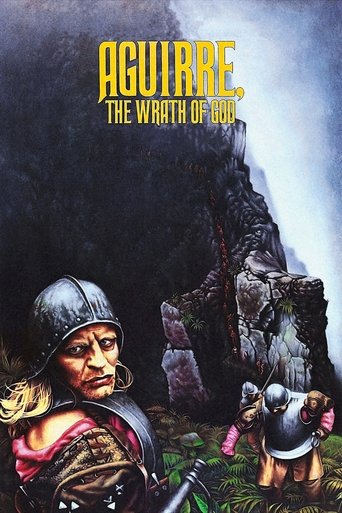
Aguirre, the Wrath of God (1972)
Aguirre, der Zorn Gottes
A breathtaking journey into the heart of darkness.
A few decades after the destruction of the Inca Empire, a Spanish expedition led by the infamous Aguirre leaves the mountains of Peru and goes down the Amazon River in search of the lost city of El Dorado. When great difficulties arise, Aguirre’s men start to wonder whether their quest will lead them to prosperity or certain death.
- Date of release
- 1972-12-29
- TMDB
- 7.4 / 10 (1320)
- Runtime
- 1h 35m
- Genres
- History, Adventure, Drama
- Director
- Werner Herzog
Casting
- Klaus Kinski — Don Lope de Aguirre
- Helena Rojo — Inés de Atienza
- Del Negro — Brother Gaspar de Carvajal
- Ruy Guerra — Don Pedro de Ursúa
- Peter Berling — Don Fernando de Guzmán
- Cecilia Rivera — Flores, Aguirre's Daughter
- Daniel Ades — Perucho
- Edward Roland — Okello
- Alexandra Cheves
- Armando Polanah — Armando
- Daniel Farfán
- Julio E. Martínez
Interesting facts
- Awards: 0 · Nominations: 1
Aguirre, the Wrath of God is a 1972 epic historical drama film produced, written and directed by Werner Herzog. Klaus Kinski stars in the title role of Spanish soldier Lope de Aguirre, who leads a group of conquistadores down the Amazon River in South America in search of the legendary city of gold, El Dorado. The accompanying soundtrack was composed and performed by kosmische musik band Popol Vuh. The film is an international co-production between West Germany, Mexico, and Peru.
Production
The idea for the film began when Herzog borrowed a book on historical adventurers from a friend. After reading a half-page devoted to Lope de Aguirre, the filmmaker became inspired and immediately devised the story. He fabricated most of the plot details and characters, although he did use some historical figures in purely fictitious ways.
Herzog wrote the screenplay "in a frenzy" in two-and-a-half days. Much of the script was written during a 200-mile (320 km) bus trip with Herzog's football team. His teammates got drunk after winning a game and one vomited on several pages of Herzog's manuscript, which he immediately threw out the window. Herzog claims that he cannot remember what he wrote on these pages.
The screenplay was mostly shot as written, with only minor differences. In an early scene in which Pizarro instructs Ursúa to lead the scouting team down the river, in the script, Pizarro mentions that in the course of the expedition Ursúa could possibly discover what happened to Francisco de Orellana's expedition, which had vanished without a trace years before (see "Historical Accuracy" section).
Further down the river, they discover another ship lodged in the treetops. In the screenplay, Aguirre and others explore the boat but find no sign of Orellana or his men. Herzog ultimately eliminated any such references to Orellana's expedition from the film. The sequence with the boat caught in the upper branches of a tree remains, but as filmed it seems to be simply a hallucinatory vision.
The finale is significantly different from Herzog's original script. The director recalled, "I only remember that the end of the film was totally different. The end was actually the raft going out into the open ocean and being swept back inland, because for many miles you have a counter-current, the Amazon actually goes backwards. And it was tossed to and fro. And a parrot would scream: 'El Dorado, El Dorado'".
Read on Wikipedia · Text from Wikipedia, CC BY-SA 4.0. Data from Wikidata.
Recommended
- Fitzcarraldo 1982 · ★ 7.6
- Kings of the Sun 1963 · ★ 6.2
- 1492: Conquest of Paradise 1992 · ★ 6.3
- The Mission 1986 · ★ 7.4
- The Last of the Mohicans 1920 · ★ 6.4
- Gold 2016 · ★ 6.6
- True Spirit 2023 · ★ 7.0
- Abraham 1993 · ★ 7.2
- The Mosquito Coast 1986 · ★ 6.4
- The Count of Monte Cristo 2002 · ★ 7.7
- The Way West 1967 · ★ 6.1
- The Bible: In the Beginning... 1966 · ★ 7.3