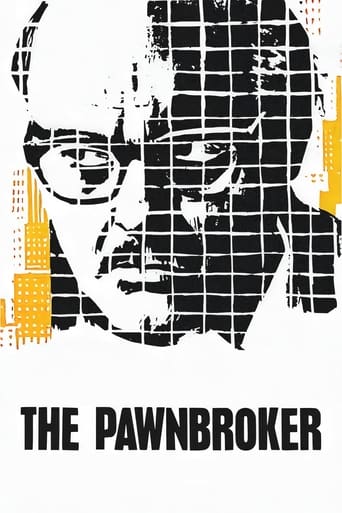
The Pawnbroker (1965)
The Most Talked About Picture!
A Jewish pawnbroker, a victim of Nazi persecution, loses all faith in his fellow man until he realizes too late the tragedy of his actions.
- Date of release
- 1965-04-20
- TMDB
- 7.1 / 10 (185)
- Runtime
- 1h 56m
- Genres
- Drama
- Director
- Sidney Lumet
Casting
- Rod Steiger — Sol Nazerman
- Geraldine Fitzgerald — Marilyn Birchfield
- Brock Peters — Rodriguez
- Jaime Sánchez — Jesus Ortiz
- Thelma Oliver — Ortiz's Girl
- Marketa Kimbrell — Tessie
- Juano Hernandez — Mr. Smith
- Linda Geiser — Ruth
- Nancy R. Pollock — Bertha
- Raymond St. Jacques — Tangee
- Baruch Lumet — Mendel
- John McCurry — Buck
Interesting facts
- Awards: 0 · Nominations: 1
The Pawnbroker is a 1964 American drama film directed by Sidney Lumet, starring Rod Steiger, Geraldine Fitzgerald, Brock Peters, Jaime Sánchez, and Morgan Freeman in his feature film debut. The screenplay was an adaptation by Morton S. Fine and David Friedkin of the 1961 novel of the same name by Edward Lewis Wallant.
Production notes
The film initially was considered for production in London, in order to take advantage of financial incentives then available for filmmakers.
Directors Stanley Kubrick, Karel Reisz and Franco Zeffirelli turned down the project. Kubrick said he thought Steiger was not "all that exciting". Reisz, whose parents were murdered in the Holocaust, said that for "deep, personal" reasons he "could not objectively associate himself with any subject which has a background of concentration camps".
Steiger became involved in the project in 1962, a year after the Wallant novel was published, and was involved in an early reworking of the film's script. He received $50,000 for his performance, far lower than his usual rate, because he trusted Lumet, with whom he had worked on television in the series You Are There.
Lumet, who took over the film after Arthur Hiller was fired, initially had misgivings about Steiger being cast in the lead role. He felt that Steiger "was a rather tasteless actor—awfully talented, but completely tasteless in his choices". Lumet preferred James Mason for the role, and the comedian Groucho Marx was among the performers who had wanted to play Nazerman.
In a 1999 television interview, Rod Steiger revealed an inspiration he took from an unlikely source of art. Over a quarter of a century after artist Pablo Picasso's 1937 Guernica, the painting inspired emotional artistic depth again when, in 1964, Steiger borrowed the silent anguish of the skyward cry of the suffering female subject, seen at the right of the canvas. The scene in the film was in the last minutes of The Pawnbroker.
Read on Wikipedia · Text from Wikipedia, CC BY-SA 4.0. Data from Wikidata.
Recommended
- The Courageous Heart of Irena Sendler 2009 · ★ 7.4
- Freedom Writers 2007 · ★ 7.9
- Schindler's List 1993 · ★ 8.6
- Adam Resurrected 2008 · ★ 6.1
- Conspiracy 2001 · ★ 7.3
- The World Will Tremble 2025 · ★ 7.5
- The Wizard of Lies 2017 · ★ 6.6
- Disgrace 2008 · ★ 6.2
- Rogue Trader 1999 · ★ 5.9
- 25th Hour 2002 · ★ 7.3
- The Boys from Brazil 1978 · ★ 6.7
- Nuremberg 2025 · ★ 7.6