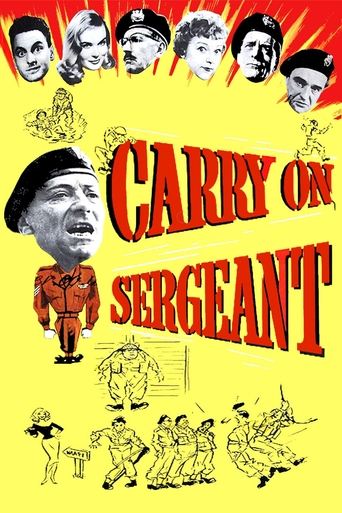
Carry On Sergeant (1958)
It’s all about a Dad . . . a Draftee . . . and a Detonation heard round the camp!
Sergeant Grimshawe wants to retire in the flush of success by winning the Star Squad prize with his very last platoon of newly called-up National Servicemen. But a motley bunch they turn out to be, and it's up to Grimshawe to put the no-hopers through their paces.
- Date of release
- 1958-08-31
- TMDB
- 6.4 / 10 (79)
- Runtime
- 1h 24m
- Genres
- Comedy, War
- Director
- Gerald Thomas
- Collection
- Carry On Collection
Casting
- William Hartnell — Sergeant Grimshawe
- Bob Monkhouse — Private Charlie Sage
- Shirley Eaton — Mary Sage
- Eric Barker — Captain Potts
- Dora Bryan — Norah
- Bill Owen — Corporal Bill Copping
- Charles Hawtrey — Private Peter Golightly
- Kenneth Connor — Private Horace Strong
- Kenneth Williams — Private James Bailey
- Terence Longdon — Private Miles Haywood
- Norman Rossington — Private Herbert Brown
- Gerald Campion — Private Andy Calloway
Interesting facts
- Box office: £500K
- Budget: £73K
- Earned 6.8× its budget
- Filmed in: Pinewood Studios
Carry On Sergeant is a 1958 British comedy film about national service starring William Hartnell, Bob Monkhouse and Eric Barker; it is the first in the series of Carry On films, with 31 entries released from 1958 to 1992. The film was based on a play The Bull Boys by R. F. Delderfield and was adapted into a script by Norman Hudis with John Antrobus contributing additional material and replacing the conscripted ballet dancers of the novel with a married couple. It was directed by Gerald Thomas and produced by Peter Rogers, a partnership which would last until 1978.
Production
In 1955, film producer Sydney Box approached author R. F. Delderfield to write a screenplay about National Service in the United Kingdom. The project was shelved until 1957 with Delderfield planning to write the screenplay of an ensemble cast film with the working title of The Bull Boys.
Events overtook the film producers when the War Office White Paper of 1957 recommended the end of National Service. Box approached his brother-in-law Peter Rogers then the head of Beaconsfield Film Studios with the pair agreeing that the route to take was making fun of National Service, particularly due to the success of the 1956 Boulting brothers film Private's Progress and the 1957-1962 television series The Army Game.
Rogers had had difficulty sourcing a screenwriter, being rejected by Eric Sykes, Spike Milligan, Ray Galton, and Alan Simpson. Alfred Shaughnessy says Rogers offered him the chance of directing the script if he rewrote it but Shaughnessy turned it down as it was "not my cup of tea".
John Antrobus wrote an early draft, of which some scenes survive in the final film. Then Rogers collaborated with Norman Hudis who wrote the final script. Hudis felt his main contribution to the series was changing the story so the soldiers rallied around to help their sergeant win his bet.
The movie was financed by Nat Cohen and Stuart Levy at Anglo-Amalgamated who had enjoyed a big success with The Tommy Steele Story also made by Rogers and Hudis.
Read on Wikipedia · Text from Wikipedia, CC BY-SA 4.0. Data from Wikidata.
Recommended
- What Did You Do in the War, Daddy? 1966 · ★ 5.9
- Hot Shots! Part Deux 1993 · ★ 6.6
- Hot Shots! 1991 · ★ 6.6
- Major Payne 1995 · ★ 6.5
- Oh! What a Lovely War 1969 · ★ 6.7
- Carry On Spying 1964 · ★ 6.3
- Private Valentine: Blonde & Dangerous 2008 · ★ 6.2
- Playing with Fire 2019 · ★ 6.5
- The League of Gentlemen 1960 · ★ 7.1
- Austin Powers: International Man of Mystery 1997 · ★ 6.6
- Fun with Dick and Jane 1977 · ★ 6.6
- The Adventure of Sherlock Holmes' Smarter Brother 1975 · ★ 6.0