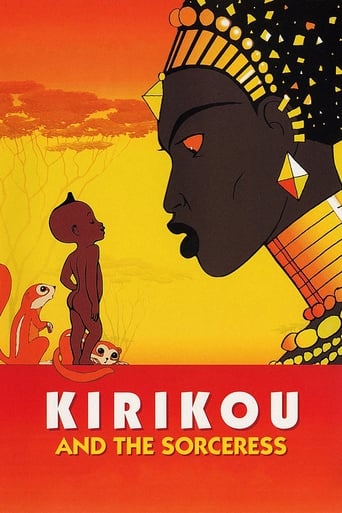
Kirikou and the Sorceress (1998)
Kirikou et la Sorcière
Can Kirikou save his village from a terrible curse?
Drawn from elements of West African folk tales, it depicts how a newborn boy, Kirikou, saves his village from the evil witch Karaba.
- Date of release
- 1998-12-09
- TMDB
- 7.4 / 10 (1204)
- Runtime
- 1h 11m
- Genres
- Fantasy, Adventure, Animation, Family
- Director
- Michel Ocelot
- Collection
- The Kirikou Collection
Casting
- Doudou Gueye Thiaw — Kirikou enfant (voice)
- Maimouna N'Diaye — La Mère (voice)
- Awa Sène Sarr — Karaba (voice)
- Robert Liensol — Le Sage dans la montagne (voice)
- William Nadylam — Kirikou jeune homme (voice)
- Sebastien Hebrant — Kirikou jeune homme (voice)
- Thilombo Lubambu — L'Oncle (voice)
- Rémi Bichet — Kirikou adulte
- Marie Augustine Diatta — La femme forte
- Moustapha Diop — Le fétiche sur le toit
- Isseu Niang — La femme maigre
- Selly Raby Kane — La grande fille
Interesting facts
- Awards: 2 · Nominations: 0. Including: Annecy Cristal for a Feature Film; CICFF Children's Jury Award for Best Animated Short Film
Kirikou and the Sorceress is a 1998 French-language animated adventure fantasy film written and directed by Michel Ocelot. Drawn from elements of West African folk tales, it depicts how a newborn boy, Kirikou, saves his village from the evil witch Karaba. The film was originally released on 9 December 1998. It is a co-production between companies in France, Belgium and Luxembourg and animated at Rija Films' studio in Latvia and Studio Exist in Hungary.
Production
The film was a co-production of Les Armateurs, Trans Europe Film, Studio O, France 3 cinéma, RTBF and Exposure in France, Odec Kid Cartoons in Belgium and Monipoly in Luxembourg. It was animated at Rija Films' animation studio in Latvia and Studio Exist in Hungary, with backgrounds painted at Les Armateurs and Paul Thiltges' animation studio, Tiramisu, in Luxembourg, digital ink and paint and compositing by Les Armateurs and Odec Kid Cartoons in…
The original French voice acting was performed by a cast of West African actors and schoolchildren and recorded in Dakar. The English dubbing, also directed by Ocelot, was made in South Africa. A dub of the film in the Swahili language was produced in Tanzania in 2009 through the help of the Danish Film Institute (DFI) and John Riber of Media for Development in Dar es Salaam.
Kirikou and the Sorceress was a low-budget film: one of the producers, Didier Brunner, explains this by the fact that the film was seen as an art/experimental project in the eyes of investors, as opposed to other more commercial projects (such as A Monkey's Tale by Jean-François Laguionie, which was closer to mainstream animated films like Disney).
Two years were needed to gather sufficient financial support for the film, and four years were needed for its actual production. The final budget of the film amounted to a total of 25 million francs at the time, or 3.8 million euros.
Michel Ocelot wrote the screenplay, although it was loosely inspired by African folktales. He found the initial idea in a collection of popular traditional stories from West Africa, compiled by Equilbecq, an administrator from the French Colonies, in 1912.
Read on Wikipedia · Text from Wikipedia, CC BY-SA 4.0. Data from Wikidata.
Recommended
- Asterix and the Vikings 2006 · ★ 6.1
- Welcome to Smelliville 2021 · ★ 6.7
- A Tooth Fairy Tale 2025 · ★ 8.5
- Azur & Asmar: The Princes' Quest 2006 · ★ 7.7
- The Pagemaster 1994 · ★ 6.4
- Ella Enchanted 2004 · ★ 6.5
- Shorts 2009 · ★ 5.9
- The Blue Bird 1940 · ★ 5.9
- Pachamama 2018 · ★ 7.2
- The Princess and the Goblin 1991 · ★ 5.8
- The Hunchback of Notre Dame 1996 · ★ 7.1
- Casper Meets Wendy 1998 · ★ 5.9