Mind Game (2004)
マインド・ゲーム
This Story Has Never Ended.
Nishi is a loser who has a crush on his childhood girlfriend. After an encounter with the Japanese mafia, he journeys to heaven and back, and ends up trapped in an even more unlikely place.
- Date of release
- 2004-08-07
- TMDB
- 7.5 / 10 (358)
- Runtime
- 1h 43m
- Genres
- Animation, Romance, Comedy, Drama, Fantasy, Adventure
- Director
- Masaaki Yuasa
Casting
- Koji Imada — Nishi (voice)
- Sayaka Maeda — Myon (voice)
- Seiko Takuma — Yan (voice)
- Takashi Fujii — Jiisan (voice)
- Tomomitsu Yamaguchi — Ryou (voice)
- Rintaro Nishi — Yakuza (voice)
- Kenichi Chujou — Atsu (voice)
- Hiroyuki Kohori — Radio DJ (voice)
- Shuji Kawatani — Radio DJ (voice)
- Naomi Shindo — Myon's Mother (voice)
- Yoshiro Matsumoto — Gang Member A (voice)
- 椛田早紀 — Outa (voice)
Interesting facts
- Awards: 1 · Nominations: 0. Including: Ōfuji Noburō Award
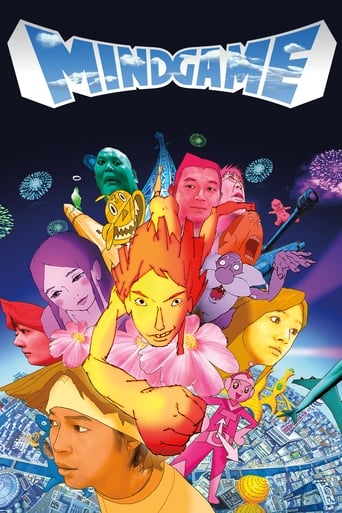
Mind Game is a 2004 Japanese adult-animated experimental comedy-drama film based on Robin Nishi's manga of the same name. It was planned, produced and primarily animated by Studio 4°C, and adapted and directed by Masaaki Yuasa in his directorial debut, with chief animation direction and model sheets by Yūichirō Sueyoshi, art direction by Tōru Hishiyama and groundwork and further animation direction by Masahiko Kubo.
Production
The proposal to adapt the manga Mind Game into a film came from Studio 4°C producer Eiko Tanaka. Kōji Morimoto, who belonged to the studio at the time, had originally discovered the manga and recommended it to studio staff and others around him. When Tanaka happened to pick it up, she decided, "We absolutely have to bring this to the screen ourselves".
To capture the atmosphere of the original story, which is set in the streets of Osaka Prefecture, the production collaborated with Yoshimoto Kogyo, a company closely associated with Osaka, and many of its comedians took part. In addition to providing voice performances, they appeared in live-action footage of their faces, which was processed and used in the animation.
The film uses a technique in which live-action footage is occasionally inserted abruptly into the animation: characters' appearances are replaced with the actual faces of the performers voicing them, while distinctive perspectives based on live-action footage heighten the psychological portrayal.
The score was composed by Seiichi Yamamoto, known for his work across multiple artistic disciplines. Pieces were created in a range of genres, including rock and bossa nova. Shinichirō Watanabe, who had worked on Cowboy Bebop and The Animatrix, served as producer. In addition to Yamamoto, Watanabe brought in composer Yoko Kanno, who contributed a solo piano performance of Hungarian Rhapsody No. 2 in C♯ minor.
The film took about two years to complete. However, it could not be released without approval from Eirin, so Tanaka initially expected it to receive an R18+ rating. When it was shown to Eirin's reviewers, however, they responded far more favorably than expected, and it was ultimately released without any age restriction. Tanaka said this also gave her confidence in the film.
Read on Wikipedia · Text from Wikipedia, CC BY-SA 4.0. Data from Wikidata.
Recommended
- Fruits Basket -prelude- 2022 · ★ 6.9
- The Relative Worlds 2019 · ★ 5.9
- xxxHOLiC The Movie: A Midsummer Night's Dream 2005 · ★ 6.6
- Aura: Koga Maryuin's Last War 2013 · ★ 6.7
- Highlander: The Search for Vengeance 2007 · ★ 7.2
- One Piece: Heart of Gold 2016 · ★ 7.3
- The Garden of Sinners: A Study in Murder - Part 2 2009 · ★ 7.1
- Inuyasha the Movie 2: The Castle Beyond the Looking Glass 2002 · ★ 7.7
- Genius Party 2007 · ★ 6.5
- Fist of the North Star: Legend of Raoh - Chapter of Fierce Fighting 2007 · ★ 6.5
- The Seven Deadly Sins: Grudge of Edinburgh Part 2 2023 · ★ 7.2
- JUJUTSU KAISEN: Execution 2025 · ★ 6.1