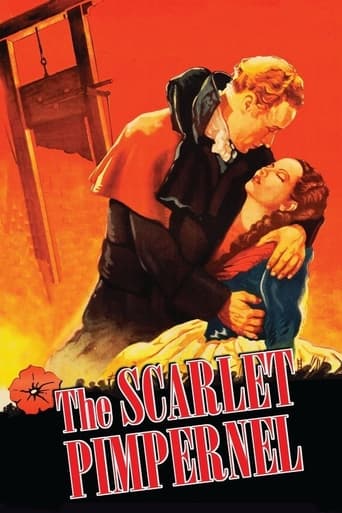
The Scarlet Pimpernel (1934)
Match courage with courage... meet cunning with cunning!
18th century English aristocrat Sir Percy Blakeney leads a double life. He appears to be merely the effete aristocrat, but in reality is part of an underground effort to free French nobles from Robespierre's Reign of Terror.
- Date of release
- 1934-12-20
- TMDB
- 7.0 / 10 (75)
- Runtime
- 1h 37m
- Genres
- Drama, Adventure
- Director
- Harold Young
Casting
- Leslie Howard — Sir Percy Blakeney / The Scarlet Pimpernel
- Merle Oberon — Lady Marguerite Blakeney
- Raymond Massey — Chauvelin
- Nigel Bruce — The Prince of Wales
- Bramwell Fletcher — The Priest
- Anthony Bushell — Sir Andrew Ffoulkes
- Joan Gardner — Suzanne de Tournay
- Walter Rilla — Armand St. Just
- Mabel Terry-Lewis — Countess de Tournay
- O.B. Clarence — Count de Tournay
- Ernest Milton — Robespierre
- Edmund Breon — Col. Winterbottom
Interesting facts
- Based on: The Scarlet Pimpernel
The Scarlet Pimpernel is a 1934 British adventure film starring Leslie Howard, Merle Oberon, and Raymond Massey. It was directed by Harold Young and produced by Alexander Korda. Based on the 1905 play by Baroness Orczy and Montagu Barstow and the 1905 adventure novel by Orczy, the film is about an 18th-century English aristocrat (Howard) who leads a double life, passing himself off as an effete aristocrat while engaged in a secret effort to rescue French nobles from Robespierre's Reign of Terror. Howard's portrayal of the title character is often considered the definitive portrayal of the role. In 1941, he played a similar role in "Pimpernel" Smith but this time set in pre-WWII Germany.
Production
By 1934, Alexander Korda was attempting to elevate the British film industry to the perceived level of the American film industry. To do so, he decided to import American directors to work on his films, inviting (among others) image-oriented writer-director Rowland Brown to direct The Scarlet Pimpernel—a huge opportunity for the young director.
Korda, a Hungarian born in a town not far from Pimpernel authoress Baroness Orczy's farm, had recently had great success with the actor Charles Laughton in the film The Private Life of Henry VIII, so he asked Laughton to play the role of Sir Percy. When the announcement went out to the press, the reaction from the Pimpernel's many fans was negative; the pug-nosed Laughton was thought a poor choice to play the suave Sir Percy.
Not long after filming began, Korda arrived on the set to observe Brown at work. He told Brown that he was directing the classic like a gangster film. Raymond Massey, who witnessed the scene, wrote "Brown announced he would direct the way he liked or walk out.
Read on Wikipedia · Text from Wikipedia, CC BY-SA 4.0. Data from Wikidata.
Recommended
- Les Misérables 2012 · ★ 7.3
- Barry Lyndon 1975 · ★ 8.0
- The Prince and the Pauper 1937 · ★ 6.8
- An Inspector Calls 1954 · ★ 7.2
- National Treasure: Book of Secrets 2007 · ★ 6.4
- The Man in the Iron Mask 1977 · ★ 6.4
- All Is True 2018 · ★ 6.0
- The Locket 1946 · ★ 6.3
- A Double Life 1947 · ★ 6.4
- A Dog's Purpose 2017 · ★ 7.6
- The Dark Corner 1946 · ★ 6.6
- The Last of the Mohicans 1920 · ★ 6.4