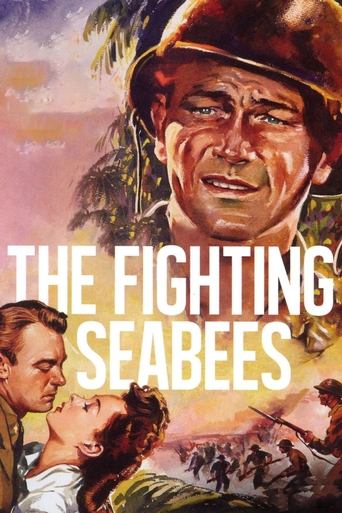
The Fighting Seabees (1944)
The thrilling story of America's supermen!
Construction workers in World War II in the Pacific are needed to build military sites, but the work is dangerous and they doubt the ability of the Navy to protect them. After a series of attacks by the Japanese, something new is tried, Construction Battalions (CBs=Seabees). The new CBs have to both build and be ready to fight.
- Date of release
- 1944-01-27
- TMDB
- 6.2 / 10 (60)
- Runtime
- 1h 40m
- Genres
- Drama, Action, War
- Director
- Edward Ludwig
Casting
- John Wayne — Lt. Cmdr. Wedge Donovan
- Susan Hayward — Constance Chesley
- Dennis O'Keefe — Lt. Cmdr. Robert Yarrow
- William Frawley — Eddie Powers
- Leonid Kinskey — Johnny Novasky
- J.M. Kerrigan — Sawyer Collins
- Grant Withers — Whanger Spreckles
- Paul Fix — Ding Jacobs
- Ben Welden — Yump Lumkin
- William Forrest — Lt. Tom Kerrick
- Addison Richards — Capt. Joyce
- Jay Norris — Joe Brick
Interesting facts
- Filmed in: San Diego
- Awards: 0 · Nominations: 1
The Fighting Seabees is a 1944 American war film directed by Edward Ludwig and starring John Wayne and Susan Hayward. The supporting cast includes Dennis O'Keefe, William Frawley, Leonid Kinsky, Addison Richards and Grant Withers. The Fighting Seabees portrays a heavily fictionalized account of the dilemma that led to the creation of the U.S. Navy's "Seabees" in World War II. At the 17th Academy Awards, the film received a nomination for Best Scoring of a Dramatic or Comedy Picture for Walter Scharf and Roy Webb but the award went to Max Steiner for Since You Went Away.
Production
The Fighting Seabees had the biggest budget in Republic's history, $1.5 million. The film was completed in collaboration with the US Navy and the US Marine Corps, and took place on several bases in California (Camp Hueneme and Camp Pendleton), Virginia (Camp Peary) and Rhode Island (Camp Endicott). Principal photography took place from September 20 to early December 1943.
The bulk of the outdoor locations for The Fighting Seabees was filmed on the Iverson Movie Ranch in Chatsworth, Calif., widely considered to be the most heavily filmed outdoor filming location in the history of film and television. The production took over virtually the entire 500-acre location ranch for a period of time in 1943, constructing extensive sets on both the Upper Iverson and the Lower Iverson.
A massive landing strip was constructed on the Upper Iverson to simulate the takeoffs and landings of combat aircraft, as well as enemy bombing raids on the U.S.-built installation. On other parts of the ranch, Quonset huts, observation towers, large fuel tanks and other props were built, with the construction process in many cases filmed and featured as part of the film.
The aircraft in The Fighting Seabees were:
Read on Wikipedia · Text from Wikipedia, CC BY-SA 4.0. Data from Wikidata.
Recommended
- Halls of Montezuma 1951 · ★ 6.0
- Paradise Road 1997 · ★ 6.3
- Run Silent, Run Deep 1958 · ★ 7.0
- Greyhound 2020 · ★ 7.4
- The Cruel Sea 1953 · ★ 6.9
- Pearl Harbor 2001 · ★ 6.9
- Heaven Knows, Mr. Allison 1957 · ★ 6.9
- Flying Leathernecks 1951 · ★ 5.8
- Waiting for Anya 2020 · ★ 6.3
- The Codes of War 2025 · ★ 6.2
- The Guns of Navarone 1961 · ★ 7.3
- Midway 1976 · ★ 6.6