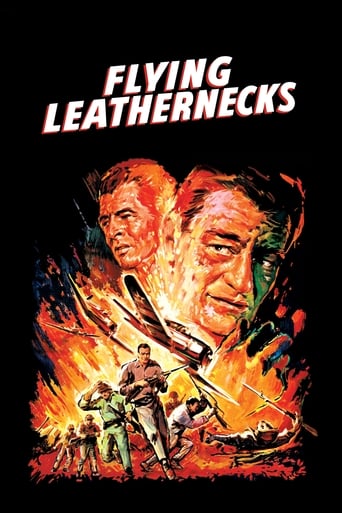
Flying Leathernecks (1951)
From Guadalcanal to Okinawa...the Marine air-devils blazed a trail of glory...while the women they left behind fought battles of their own!
Major Daniel Kirby takes command of a squadron of Marine fliers just before they are about to go into combat. While the men are well meaning, he finds them undisciplined and prone to always finding excuses to do what is easy rather than what is necessary. The root of the problem is the second in command, Capt. Carl 'Griff' Griffin. Griff is the best flier in the group but Kirby finds him a poor commander who is not prepared to make the difficult decision that all commanders have to make - to put men in harm's way knowing that they may be killed.
- Date of release
- 1951-08-28
- TMDB
- 5.8 / 10 (78)
- Runtime
- 1h 42m
- Genres
- War, Action, Drama
- Director
- Nicholas Ray
Casting
- John Wayne — Maj. Daniel Xavier Kirby
- Robert Ryan — Capt. Carl 'Griff' Griffin
- Don Taylor — Lt. Vern 'Cowboy' Blithe
- Janis Carter — Joan Kirby
- Jay C. Flippen — MSgt. Clancy, Line Chief
- William Harrigan — Dr. Lt.Cdr. Joe Curran
- James Bell — Colonel
- Barry Kelley — Brigadier General
- Maurice Jara — Shorty Vegay
- Adam Williams — Lt. Bert Malotke
- James Dobson — Lt. Pudge McCabe
- Carleton Young — Col. Riley
Interesting facts
- Box office: $2.6M
Flying Leathernecks is a 1951 American Technicolor action war film directed by Nicholas Ray, produced by Edmund Grainger and starring John Wayne and Robert Ryan. The film details the exploits and personal battles of Marine Corps aviators, known as "leathernecks", during World War II.
Production
As indicated in the opening scene of the film, Howard Hughes, himself a pilot with an interest in aviation, bankrolled the production. Hughes made the decision to film in Technicolor, making use of color wartime combat footage.
Principal photography began in November 1950 at Camp Pendelton and El Toro Marine Corps bases and then moved to RKO-Pathé Studios in February 1951 for soundstage sequences. The fighter aircraft appearing in the first part of the film are not the historically accurate Grumman F4F Wildcats but Grumman F6F Hellcats, provided from the training units at El Toro.
During filming, a near disaster occurred when stunt pilot Paul Mantz and his photo crew, while filming a low-altitude attack, were caught in a premature dynamite detonation. The B-25 camera platform was badly damaged, but Mantz successfully executed an emergency landing.
The role of Major Kirby was inspired by real World War II flying ace Major John L. Smith for his missions over Guadalcanal in 1942. His actions in the war were renowned by the time when the film was made. Smith was awarded the Medal of Honor in 1943 and later promoted to lieutenant colonel, as was Kirby in the film. A distinct similarity in appearance between Smith and John Wayne was noted.
Read on Wikipedia · Text from Wikipedia, CC BY-SA 4.0. Data from Wikidata.
Recommended
- Flying Tigers 1942 · ★ 6.3
- Top Gun: Maverick 2022 · ★ 8.2
- Sands of Iwo Jima 1950 · ★ 6.4
- Pearl Harbor 2001 · ★ 6.9
- The Sea Chase 1955 · ★ 6.3
- Halls of Montezuma 1951 · ★ 6.0
- The Wings of Eagles 1957 · ★ 6.3
- Midway 1976 · ★ 6.6
- The Fighting Seabees 1944 · ★ 6.2
- Memphis Belle 1990 · ★ 6.8
- Aces High 1976 · ★ 5.9
- The First of the Few 1942 · ★ 6.7