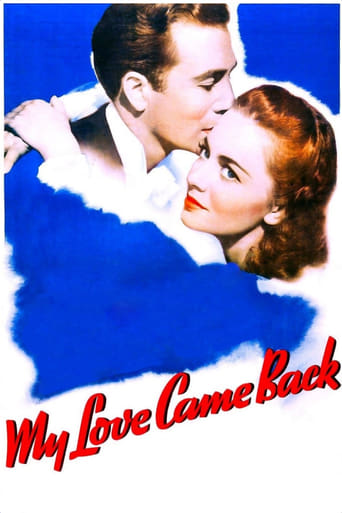
My Love Came Back (1940)
Amelia ist eine begabte Geigerin, die kurz davor steht, die Brissac Academy of Music zu verlassen. Julius veranlasst über seinen Mitarbeiter Tony, dass ihr ein Stipendium gewährt wird, damit er sie zu allen Musikveranstaltungen der Stadt begleiten kann.
- Erscheinungsdatum
- 1940-07-13
- TMDB
- 4.9 / 10 (8)
- Laufzeit
- 1 Std. 25 Min.
- Genres
- Komödie, Drama, Musik
- Regie
- Curtis Bernhardt
Besetzung
- Olivia de Havilland — Amelia Cornell
- Jeffrey Lynn — Tony Baldwin
- Eddie Albert — Dusty Rhodes
- Jane Wyman — Joy O'Keefe
- Charles Winninger — Julius Malette
- Spring Byington — Clara Malette
- Grant Mitchell — Dr. Kobbe
- William T. Orr — Paul Malette
- Ann Gillis — Valerie Malette
- S.Z. Sakall — Geza Peyer
- Charles Trowbridge — Dr. Downey
- Mabel Taliaferro — Dowager
Wissenswertes
- Basiert auf: Episode
My Love Came Back is a 1940 American comedy-drama film directed by Curtis Bernhardt and starring Olivia de Havilland, Jeffrey Lynn, Eddie Albert, and Jane Wyman. Based on the 1935 Austrian film Episode written and directed by Walter Reisch, the film is about a gifted young violinist who considers leaving a prestigious music academy to play in a jazz band to earn money. The academy's new president—a distinguished wealthy patron of the arts—convinces her to stay after secretly arranging a scholarship for her out of his own pocket, and the two begin attending concerts together. Complications arise when he asks his young business manager to take his place at one of the concerts.
Production
My Love Came Back is based on the Austrian film Episode, which was directed by Walter Reisch and starred Paula Wessely and Karl Ludwig Diehl. Episode was in fact a sequel to another Austrian film, Maskerade—which was remade by MGM in 1935 under the title Escapade. The working titles for My Love Came Back were Episode, Men on Her Mind, and Two Loves Have I.
"Overture" from Orpheus in the Underworld (Jacques Offenbach) performed by the student orchestra
"Hungarian Rhapsody No. 2 in C Sharp Minor" (Franz Liszt) played on a record, swing version performed by Dusty (piano) and Amelia (violin)
"Long, Long Ago" (Thomas Haynes Bayley) played when Julius tells Clara he has to go out
"Wedding March" from A Midsummer Night's Dream, Op. 61 (Felix Mendelssohn-Bartholdy) played on piano by Valerie and Paul
Auf Wikipedia weiterlesen · Text aus Wikipedia, CC BY-SA 4.0. Daten aus Wikidata.
Empfohlen
- Feel the Beat 2020 · ★ 7.5
- Die Marx Brothers im Kaufhaus 1941 · ★ 6.3
- Music of the Heart 1999 · ★ 6.7
- Die tollkühne Rettung der Gangsterbraut Honey Swanson 1948 · ★ 6.5
- Lemonade Mouth - Die Geschichte einer Band 2011 · ★ 7.4
- Lara 2019 · ★ 6.7
- Marx Brothers - Das große Rennen 1937 · ★ 7.1
- Drumline - Ein neuer Rhythmus 2014 · ★ 6.8
- Vitus 2006 · ★ 7.4
- Bühne des Lebens 2016 · ★ 6.4
- Wild Oats 2016 · ★ 6.1
- Arlo, der Alligatorjunge 2021 · ★ 6.8