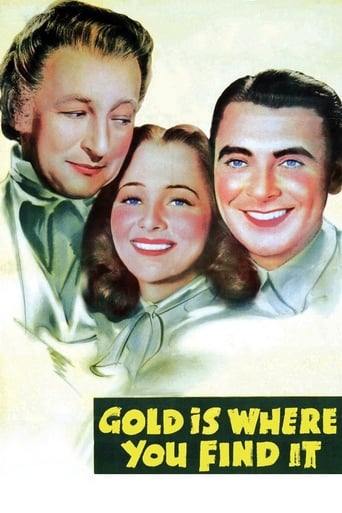
Gold Is Where You Find It (1938)
Ruthlessly...they tore down mountains, ruined land, wrecked lives! Eternally...their mighty story will stand ...the miracle of the screen!
Colonel Ferris, a wealthy farmer in northern California, is strongly opposed to hydraulic mining, a new method developed during the gold rush of the 1870's, which is flooding the area's prosperous farmlands. Despite Ferris' political stance, Jared Whitney, a mining engineer from the East, becomes friends with the colonel's son Lance and falls in love with his daughter Serena. Family tensions deepen when the colonel's brother Ralph gives up farming to go to San Francisco to work for his wife Rosanna's father, Harrison McCooey, a leader in the mining venture. When Lance follows Ralph, the colonel, focusing his anger on Jared, forbids him to see Serena.
- Date of release
- 1938-02-12
- TMDB
- 7.0 / 10 (10)
- Runtime
- 1h 34m
- Genres
- Drama, Romance, Western
- Director
- Michael Curtiz
Casting
- George Brent — Jared Whitney
- Olivia de Havilland — Serena Ferris
- Claude Rains — Colonel Ferris
- Margaret Lindsay — Rosanne
- John Litel — Ralph Ferris
- Marcia Ralston — Molly Featherstone
- Barton MacLane — Slag Martin
- Tim Holt — Lance Ferris
- Sidney Toler — Harrison McCooey
- Henry O'Neill — Judge
- Willie Best — Joshua
- Robert McWade — Mr. Crouch
Interesting facts
Gold is Where You Find It is a 1938 American Western Technicolor film that gives a fictionalized account of a true event. It was directed by Michael Curtiz and stars George Brent, Olivia de Havilland, and Claude Rains, with a screenplay by Warren Duff and Robert Buckner based on a story by Clements Ripley. This Technicolor feature film was released on February 12, 1938, by Warner Bros. Pictures.
Production notes
While stationed in South Carolina in 1919, Clements Ripley met and married Katherine (Kattie) Ball, the daughter of noted journalist W. W. Ball. They lived in North Carolina and grew peaches until 1927, when they moved to Charleston, South Carolina to become writers.
The real landmark lawsuit was Woodruff v. North Bloomfield Gravel Mining Company, brought in 1882 and settled in 1884.
This was the second Warner Bros. movie to be shot in the new three-strip Technicolor process. Filming and production started on August 23, 1937 and ended on mid/late-October 1937.
According to TCM's Brian Cady, "director Michael Curtiz's felicity with the Technicolor camera led Warner Bros. Pictures to put him in the director's chair in place of William Keighley for their next Technicolor extravaganza, The Adventures of Robin Hood (1938)."
The film was shot near Weaverville, California and was plagued by torrential rains.
Read on Wikipedia · Text from Wikipedia, CC BY-SA 4.0. Data from Wikidata.
Recommended
- Man in the Shadow 1957 · ★ 6.7
- Union Pacific 1939 · ★ 6.7
- Flamingo Road 1949 · ★ 7.0
- The Secret: Dare to Dream 2020 · ★ 7.4
- Don't Come Knocking 2005 · ★ 6.2
- Return to Peyton Place 1961 · ★ 6.6
- Love Finds You in Valentine 2016 · ★ 6.4
- Barbary Coast 1935 · ★ 6.4
- Broken Arrow 1950 · ★ 6.7
- The Longest Ride 2015 · ★ 7.6
- My Brilliant Career 1979 · ★ 6.2
- Into the West 1992 · ★ 6.4