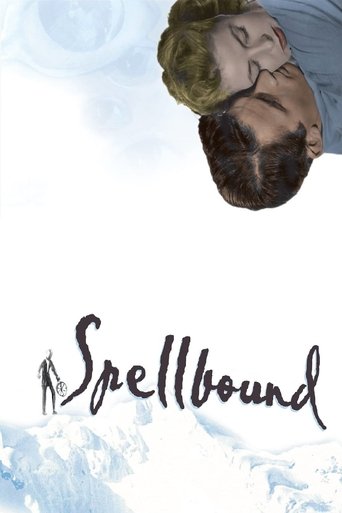
Spellbound (1945)
This is love! Complete...reckless...violent!
When Dr. Anthony Edwardes arrives at a Vermont mental hospital to replace the outgoing hospital director, Dr. Constance Peterson, a psychoanalyst, discovers Edwardes is actually an impostor. The man confesses that the real Dr. Edwardes is dead and fears he may have killed him, but cannot recall anything. Dr. Peterson, however is convinced his impostor is innocent of the man's murder, and joins him on a quest to unravel his amnesia through psychoanalysis.
- Date of release
- 1945-10-31
- TMDB
- 7.4 / 10 (1047)
- Runtime
- 1h 51m
- Genres
- Drama, Mystery, Thriller
- Director
- Alfred Hitchcock
Casting
- Ingrid Bergman — Dr. Constance Petersen
- Gregory Peck — John Ballantine
- Michael Chekhov — Dr. Alexander Brulov
- Leo G. Carroll — Dr. Murchison
- Rhonda Fleming — Mary Carmichael
- John Emery — Dr. Fleurot
- Norman Lloyd — Mr. Garmes
- Bill Goodwin — House Detective
- Steven Geray — Dr. Graff
- Donald Curtis — Harry
- Wallace Ford — Stranger in Hotel Lobby
- Art Baker — Det. Lt. Cooley
Interesting facts
- Box office: $6.4M
- Budget: $1.5M
- Earned 4.3× its budget
- Awards: 1 · Nominations: 6. Including: Academy Award for Best Original Dramatic or Comedy Score
Spellbound is a 1945 American psychological thriller film directed by Alfred Hitchcock, and starring Ingrid Bergman, Gregory Peck, Michael Chekhov, and Leo G. Carroll. It follows a psychoanalyst who falls in love with the new head of the Vermont hospital in which she works. Although the film is based on the 1927 novel The House of Dr. Edwardes by Hilary Saint George Saunders and John Palmer, the plots are dramatically different.
Production
Spellbound was made over contract disagreements between Alfred Hitchcock and producer David O. Selznick. Hitchcock's contract with Selznick began in March 1939, but only resulted in three films: Rebecca (1940), Spellbound and The Paradine Case (1947) (he made seven other films during that period under loan-out deals to other studios, including 1946's Notorious which was sold to RKO in mid-production.) Selznick had wanted Hitchcock to make a film…
In December 1943, Hitchcock and his wife, Alma Reville, began working on a treatment of the novel, and consulted prominent British psychologists and psychoanalysts so as to accurately represent the psychological elements of the story. However, the following month, in January 1944, Hitchcock hired Angus MacPhail, with whom he had collaborated on several war-related short films, to co-author the treatment.
Between May and July 1944, Selznick submitted numerous drafts of Hecht's screenplay for approval from the Motion Picture Association of America (MPAA), which objected to various words and phrases in it, including "sex menace," "frustrations," "libido," and "tomcat." This resulted in some alterations in the screenplay, including the removal of most of a character named Mary Carmichael, a violent nymphomaniac at Green Manors.
Selznick originally wanted Joseph Cotten, Dorothy McGuire, and Paul Lukas to play the roles ultimately portrayed by Peck, Bergman, and Chekhov, respectively. Greta Garbo was considered for the role of Dr. Constance Petersen. Hitchcock wanted Joseph Cotten to portray Dr. Murchison. Selznick also wanted Jennifer Jones to portray Dr. Petersen but Hitchcock objected.
Selznick brought in his own therapist, May Romm, MD, to serve as a technical advisor on the production. Dr. Romm and Hitchcock clashed frequently.
Read on Wikipedia · Text from Wikipedia, CC BY-SA 4.0. Data from Wikidata.
Recommended
- Murder! 1930 · ★ 5.9
- Elephant Song 2015 · ★ 6.9
- The Caveman's Valentine 2001 · ★ 5.9
- Remember 2015 · ★ 7.3
- Insomnia 2002 · ★ 7.0
- Donovan's Echo 2011 · ★ 6.0
- Somewhere in the Night 1946 · ★ 6.7
- Code 46 2003 · ★ 6.2
- The Snake Pit 1948 · ★ 7.1
- The Glass Key 1942 · ★ 6.7
- Fear X 2003 · ★ 5.8
- The Mirror Crack'd 1980 · ★ 6.1