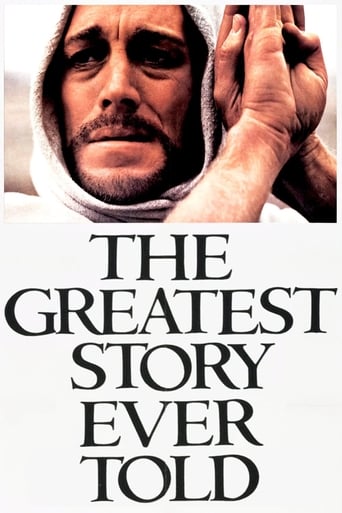
The Greatest Story Ever Told (1965)
Only once in a lifetime... an entertainment so rich... an experience so rewarding...
From his birth in Bethlehem to his death and eventual resurrection, the life of Jesus Christ is given the all-star treatment in this epic retelling. Major aspects of Christ's life are touched upon, including the execution of all the newborn males in Egypt by King Herod; Christ's baptism by John the Baptist; and the betrayal by Judas after the Last Supper that eventually leads to Christ's crucifixion and miraculous return.
- Date of release
- 1965-04-09
- TMDB
- 6.4 / 10 (226)
- Runtime
- 3h 19m
- Genres
- Drama, History
- Director
- George Stevens
Casting
- Max von Sydow — Jesus
- Michael Anderson Jr. — James the Younger
- Carroll Baker — Veronica
- Ina Balin — Martha of Bethany
- Victor Buono — Sorak
- Richard Conte — Barabbas
- Joanna Dunham — Mary Magdalene
- José Ferrer — Herod Antipas
- Van Heflin — Bar Amand
- Charlton Heston — John the Baptist
- Martin Landau — Caiaphas
- Angela Lansbury — Claudia
Interesting facts
- Filmed in: Utah and 1 more
- Awards: 1 · Nominations: 5. Including: National Board of Review: Top Ten Films
The Greatest Story Ever Told is a 1965 American epic religious film that retells the Biblical account of Jesus of Nazareth, from the Nativity through to the Ascension. Produced and directed by George Stevens, the film features an ensemble cast and includes the final film performances of Claude Rains and Joseph Schildkraut.
Production
The Greatest Story Ever Told originated in 1947 as a half-hour radio series written by Henry Denker and inspired by the four canonical Gospels. In 1949, the series was adapted into a novel by Fulton Oursler, a senior editor at Reader's Digest. In May 1954, 20th Century-Fox chairman Darryl F. Zanuck acquired the film rights to Oursler's novel for a down payment of $110,000, plus a percentage of the gross.
In November 1958, while George Stevens was filming The Diary of Anne Frank (1959) at Fox, he became aware that the studio owned the rights to the Oursler property. Stevens then founded a company, "The Greatest Story Productions", to film the novel. The studio set an initial production budget of $10 million, twice the previous largest figure.
In June 1960, Denker sued Fox to reclaim the film rights and for $2.5 million of damages, claiming the studio had failed to release the film before the end of 1959. When Denker and Oursler's estate sold the rights to Fox, Denker had placed a clause in the contract dictating the agreement. In September 1961, Fox announced it had "indefinitely postponed" the project.
Before writing the screenplay, Stevens reviewed 36 different translations of the New Testament and compiled an extensive reference book with various clippings of scripture. Stevens and David Brown, a Fox executive, considered numerous screenwriters, including Ray Bradbury, Reginald Rose, William Saroyan, Joel Sayre and Ivan Moffat.
By July 1960, Carl Sandburg had been hired for completion work on the screenplay. Sandburg remained with the project for the next thirteen months, before returning to his residence in Flat Rock, North Carolina. In September 1961, Sandburg told Variety that he would continue to consult on the project "until George Stevens tells me to stop".
Read on Wikipedia · Text from Wikipedia, CC BY-SA 4.0. Data from Wikidata.
Recommended
- Jesus 1999 · ★ 6.8
- Abraham 1993 · ★ 7.2
- Risen 2016 · ★ 6.3
- Barabbas 1961 · ★ 6.9
- Jesus 1979 · ★ 8.3
- The Robe 1953 · ★ 6.8
- Mary 2024 · ★ 6.3
- Do You Believe? 2015 · ★ 6.8
- Light of the World 2025 · ★ 8.9
- The Ten Commandments 1956 · ★ 7.8
- The Young Messiah 2016 · ★ 6.3
- The Eyes of Tammy Faye 2021 · ★ 6.4