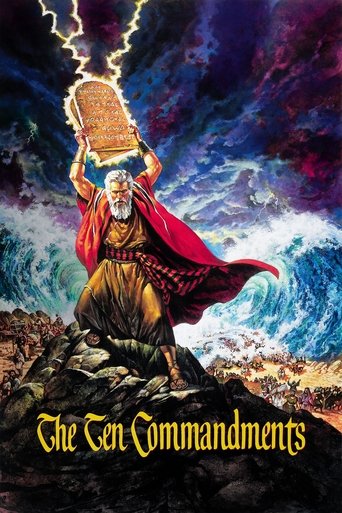
The Ten Commandments (1956)
The greatest event in motion picture history!
Escaping death, a Hebrew infant is raised in a royal household to become a prince. Upon discovery of his true heritage, Moses embarks on a personal quest to reclaim his destiny as the leader and liberator of the Hebrew people.
- Date of release
- 1956-11-08
- TMDB
- 7.8 / 10 (1963)
- Runtime
- 3h 40m
- Genres
- Drama, History
- Director
- Cecil B. DeMille
Casting
- Charlton Heston — Moses
- Yul Brynner — Rameses
- Anne Baxter — Nefretiri
- Edward G. Robinson — Dathan
- Yvonne De Carlo — Sephora
- Debra Paget — Lilia
- John Derek — Joshua
- Cedric Hardwicke — Sethi
- Nina Foch — Bithiah
- Martha Scott — Yochabel
- Judith Anderson — Memnet
- Vincent Price — Baka
Interesting facts
- Budget: $13.5M
- Awards: 1 · Nominations: 7. Including: Academy Award for Best Special Effects
The Ten Commandments is a 1956 American biblical epic film produced, directed, and narrated by Cecil B. DeMille, shot in VistaVision, and released by Paramount Pictures. Based on the Bible's Book of Exodus and other sources, it dramatizes the story of the life of Moses, an adopted Egyptian prince who becomes the deliverer of his real brethren, the enslaved Hebrews, and thereafter leads the Exodus to Mount Sinai, where he receives the titular commandments from God. The film stars Charlton Heston in the lead role, Yul Brynner as Rameses, Anne Baxter as Nefretiri, Edward G.
Production
In July 1951, while he was working on his circus film The Greatest Show on Earth, producer-director Cecil B. DeMille chose Homer's Odyssey as the subject of his next epic. Several weeks later, he announced he was going to make a film about the Book of Esther, but then he changed his mind and said he was planning a new film about Helen of Troy, which he eventually canceled.
After The Greatest Show on Earth was released, DeMille went to Paramount Pictures to discuss his next film with the studio's executives, including Barney Balaban and Adolph Zukor. He had already made up his mind to direct a new version of The Ten Commandments that would incorporate Moses' life as an Egyptian prince. He had to "sell" the idea to them and, although only Zukor and Y. Frank Freeman championed it, all accepted it.
In June 1952, DeMille formally informed the press that his next production would be a Technicolor remake of his successful silent film The Ten Commandments (1923). From the beginning, his plan was to produce the film on a "lavish scale" with "a cast of outstanding stars" and a budget that would allow it "to possess the quality and spectacular values that have earned for DeMille the title of 'Hollywood's master showman.'" DeMille explained why he…
I feel that the subject of Moses and the Ten Commandments is particularly timely today. Not only does it provide all the ingredients for exciting and spectacular motion picture entertainment for mass audiences of all ages throughout the world, but it is in line with the spiritual reawakening of all nations of the free world in these troubled times.
In October 1952, DeMille told reporter Bob Thomas, "The actual shooting is the easiest part of making a picture. It is here in the production office that the picture is really created." He was already working on methods for the parting of the Red Sea, and his initial plans included shooting Egyptian backgrounds in fall 1953, six months of Hollywood filming in 1954, and a late 1955 release date.
Read on Wikipedia · Text from Wikipedia, CC BY-SA 4.0. Data from Wikidata.
Recommended
- The Prince of Egypt 1998 · ★ 7.3
- The Robe 1953 · ★ 6.8
- Exodus: Gods and Kings 2014 · ★ 5.9
- Joseph: King of Dreams 2000 · ★ 6.9
- The Book of Daniel 2013 · ★ 7.0
- The Greatest Story Ever Told 1965 · ★ 6.4
- Abraham 1993 · ★ 7.2
- Jesus 1999 · ★ 6.8
- Palestine 36 2025 · ★ 7.6
- Ben-Hur 1959 · ★ 7.9
- Jacob 1994 · ★ 6.7
- The Young Messiah 2016 · ★ 6.3