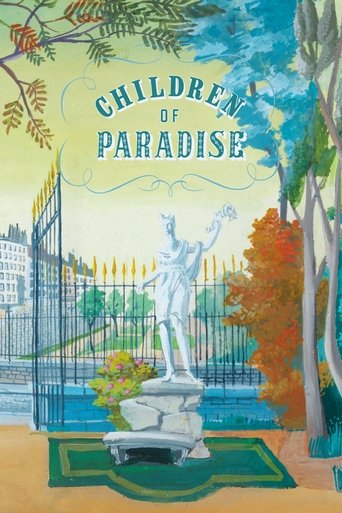
Children of Paradise (1945)
Les Enfants du Paradis
AT LAST! The Celebrated French Film.
In a chaotic 19th-century Paris teeming with aristocrats, thieves, psychics, and courtesans, theater mime Baptiste is in love with the mysterious actress Garance. But Garance, in turn, is loved by three other men: pretentious actor Frederick, conniving thief Lacenaire, and Count Edouard of Montray.
- Date of release
- 1945-03-15
- TMDB
- 8.1 / 10 (475)
- Runtime
- 3h 10m
- Genres
- Drama, Romance
- Director
- Marcel Carné
Casting
- Arletty — Claire Reine, dite Garance
- Jean-Louis Barrault — Baptiste Debureau
- Pierre Brasseur — Frédérick Lemaître
- Marcel Herrand — Pierre-François Lacenaire
- María Casares — Nathalie
- Louis Salou — Édouard comte de Montray
- Pierre Renoir — Jericho
- Jane Marken — Mme Hermine
- Gaston Modot — Fil de Soie
- Fabien Loris — Avril
- Marcel Pérès — Le directeur des Funambules
- Etienne Decroux — Anselme Debureau
Interesting facts
- Filmed in: Paris and Nice
- Awards: 0 · Nominations: 1
Children of Paradise is a two-part French romantic drama film by Marcel Carné, produced under war conditions in 1943, 1944, and early 1945. Set in the theatrical world of 1830s Paris, it tells the story of a courtesan and four men—a mime, an actor, a criminal and an aristocrat—who love her in entirely different ways.
Production
The film was made under extremely difficult conditions. External sets in Nice were badly damaged by natural causes, exacerbated and compounded by the theatrical constraints stemming from the German occupation of France during World War II. The film was split into two parts because the distributor, Gaumont, could only screen a three hour film half as many times as usual.
Barrault nearly missed performing in the film. He was committed at the time to the theatrical premiere of The Satin Slipper (Le Soulier de satin), which became a hit. He almost offered his role of Baptiste to a music hall entertainer, Jacques Tati, then little known, before a revised film production schedule was negotiated that allowed Barrault to fulfill both roles.
According to film critic Pauline Kael, it was alleged that "the starving extras made away with some of the banquets before they could be photographed". Many of the 1,800 extras were Resistance agents using the film as daytime cover. Until the liberation of France, they had to mingle with collaborators and Vichy sympathisers imposed on the production by the authorities.
The set builders were short of supplies and the camera crew's film stock was rationed. The financing, originally a French-Italian production, collapsed a few weeks after production began in Nice, due to the Allied conquest of Sicily in August 1943. Around this time, the Nazis forbade producer André Paulvé from working on the film because of his remote Jewish ancestry, and production was suspended for three months.
The movie also marks the first artistic collaboration between Carné and the French painter and costume designer Mayo, one that would continue over several films (Les Portes de la Nuit (1946), La Fleur de l'Age (1947), Juliette ou la Clef des Songes, Thérèse Raquin (1953), Les Tricheurs (1958)). This friend of Prévert started his work on the project very early in order to immerse himself fully in the script and the characters.
Read on Wikipedia · Text from Wikipedia, CC BY-SA 4.0. Data from Wikidata.
Recommended
- Ghost 1990 · ★ 7.3
- The Wild One 1953 · ★ 6.5
- You Ain't Seen Nothin' Yet 2012 · ★ 6.5
- The Last Tycoon 1976 · ★ 6.3
- Not Easily Broken 2009 · ★ 6.3
- Cyrano 2021 · ★ 6.3
- My Dinner with Hervé 2018 · ★ 6.3
- Killer's Kiss 1955 · ★ 6.3
- TalhotBlond 2012 · ★ 6.3
- Breathless 1960 · ★ 7.5
- The Cat's Meow 2002 · ★ 5.8
- Private Fears in Public Places 2006 · ★ 6.4