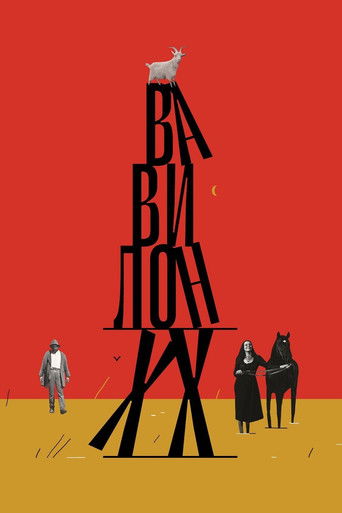
Babylon XX (1980)
Вавилон ХХ
The new reality changes the usual life in the village of Babylon. Attempts to communize the small town are met with resistance from the rich people living in the town. The Red Army finally puts down the resistance. Amidst the resistance philosopher Fabian returns to Babylon and tries to prevent bloodshed, but he meets a tragic fate.
- Date of release
- 1980-04-01
- TMDB
- 3.6 / 10 (8)
- Runtime
- 1h 35m
- Genres
- Drama
- Director
- Ivan Mykolaichuk
Casting
- Ivan Mykolaichuk — Fabian
- Lyubov Polishchuk — Malva
- Les Serdyuk — Danko
- Yaroslav Havryliuk — Lukian
- Taisiya Lytvynenko — Prisia
- Boryslav Brondukov — Yavtushok
- Lyudmila Chinshevaya — Darynka
- Anatoli Khostikoyev — poet Volodya Yavorskyi
- Ivan Havryliuk — Klym Synytsia
- Kostiantyn Stepankov — Bubela
- Vitali Rosstalnoy — Ruban
- Olga Mateshko — Parfena
Interesting facts
- Awards: 1 · Nominations: 0. Including: 100 best films in the history of Ukrainian cinema
Babylon XX is a 1979 Ukrainian film of Dovzhenko Film Studios directed by Ivan Mykolaichuk in his directorial debut and starring an ensemble cast including Mykolaichuk, Lyubov Polishchuk, and Les Serdyuk as peasants struggling to adapt to life within a commune led by Soviet sailor Klym Synytsia. It is a loose film adaptation of the 1971 novel A Flock of Swans by Vasyl Zemliak, and depicts collectivization in the Ukrainian Soviet Socialist Republic and the transition from capitalism to communism in Ukraine.
Production
Screenwriting for Babylon XX began in 1977, including both Vasyl Zemliak (author of A Flock of Swans, which Babylon XX was inspired by) and Ivan Mykolaichuk. The process of screenwriting was based on a nativity scene, with separate parts of the script representing high and low culture. Further inspiration on directorial and camera work was taken from the works of Croatian naïve art painter Ivan Generalić.
Production was significantly hampered by the fact that many of the film's actors were also working in other roles while filming. Difficulty was also found in shooting night-time scenes, an issue resolved by cinematographer Yuriy Harmash with the usage of infrared photography. More generally posing a threat to the film's production was a crackdown on Ukrainian poetic cinema by the government of the Ukrainian Soviet Socialist Republic.
Other, more minor incidents occurred during production. On one occasion, during the digging of a grave for one scene, the remains of a Cossack were discovered by Harmash, who said, "God will forgive us, but the Cossack even moreso."
Read on Wikipedia · Text from Wikipedia, CC BY-SA 4.0. Data from Wikidata.
Recommended
- Fatima 2020 · ★ 7.2
- Earth 1930 · ★ 6.7
- The Nest 2020 · ★ 6.1
- My Neighbor Adolf 2022 · ★ 6.6
- The Effect of Gamma Rays on Man-in-the-Moon Marigolds 1972 · ★ 7.3
- The Giver 2014 · ★ 6.6
- The Young One 1960 · ★ 7.0
- Waiting for the Barbarians 2020 · ★ 5.9
- Nineteen Eighty-Four 1984 · ★ 6.8
- Straw Dogs 1971 · ★ 7.1
- The Uprising 2026 · ★ 7.9
- The Road Dance 2022 · ★ 6.7