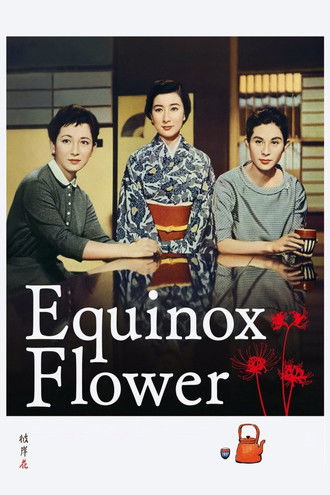
Equinox Flower (1958)
彼岸花
Wataru's outwardly liberal views on marriage are severely tested when his daughter declares her love for a coworker and is adamant to live her own way, instead of agreeing to an arranged marriage. Outwitted by his female relatives, Hirayama stubbornly refuses to admit defeat.
- Date of release
- 1958-09-07
- TMDB
- 7.4 / 10 (169)
- Runtime
- 1h 58m
- Genres
- Comedy, Drama
- Director
- Yasujirō Ozu
Casting
- Shin Saburi — Wataru Hirayama
- Kinuyo Tanaka — Kiyoko Hirayama
- Ineko Arima — Setsuko Hirayama
- Yoshiko Kuga — Fumiko Mikami
- Keiji Sada — Masahiko Taniguchi
- Teiji Takahashi — Shotaru Kondo
- Miyuki Kuwano — Hisako Hirayama
- Chishū Ryū — Shukichi Mikami
- Chieko Naniwa — Hatsu Sasaki
- Fujiko Yamamoto — Yukiko Sasaki
- Fumio Watanabe — Ichiro Nagamura
- Nobuo Nakamura — Toshihiko Kawai
Interesting facts
Equinox Flower is a 1958 color Japanese film directed by Yasujirō Ozu which is based on a novel by Ton Satomi.
Production
It is Yasujirō Ozu's first film in color, while Japan's first color film, Keisuke Kinoshita's Carmen Comes Home, had been released in 1951. Ozu chose Agfa film from Germany over Kodak or Fujifilm, as he felt that it conveyed red colors better. The meaning of "equinox flower" or "higanbana" of the title is the red Lycoris.
Shochiku requested that Ozu shoot Equinox Flower in color primarily to showcase Fujiko Yamamoto, the Daiei superstar it had borrowed for the film. The movie is constructed to spotlight the actress, who is elevated with extended dialogue scenes as a protégé of Hirayama who drives the plot resolution from the sidelines, and she won the 1958 Blue Ribbon Award as Best Actress for Equinox Flower and The Snowy Heron, which featured her in a much showie…
Read on Wikipedia · Text from Wikipedia, CC BY-SA 4.0. Data from Wikidata.
Recommended
- Late Spring 1949 · ★ 8.0
- Late Autumn 1960 · ★ 7.7
- The Flavor of Green Tea Over Rice 1952 · ★ 7.5
- An Autumn Afternoon 1962 · ★ 7.9
- In This Corner of the World 2016 · ★ 7.9
- Tokyo Story 1953 · ★ 8.2
- Crayon Shin-chan: The Storm Called: The Adult Empire Strikes Back 2001 · ★ 8.2
- About Schmidt 2002 · ★ 6.9
- A Man 2022 · ★ 7.1
- After the Rain 2000 · ★ 7.3
- From Up on Poppy Hill 2011 · ★ 7.5
- Her Love Boils Bathwater 2016 · ★ 7.4