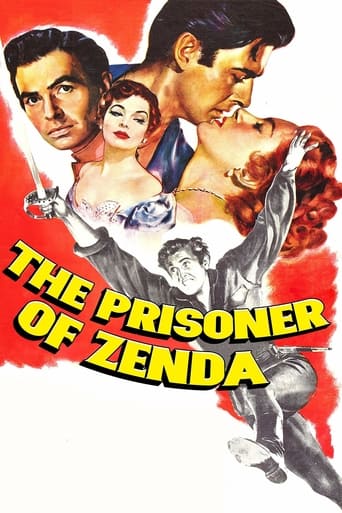
The Prisoner of Zenda (1952)
A Swashbuckling Adventure In The Grand Style!
A kingdom's ascending heir, marked for assassination, switches identities with a lookalike, who takes his place at the coronation. When the real king is kidnapped, his followers try to find him, while the stand-in falls in love with the king's intended bride, the beautiful Princess Flavia.
- Date of release
- 1952-11-04
- TMDB
- 6.9 / 10 (62)
- Runtime
- 1h 40m
- Genres
- Adventure
- Director
- Richard Thorpe
Casting
- Stewart Granger — Rudolf Rassendyll / King Rudolf V
- Deborah Kerr — Princess Flavia
- James Mason — Rupert of Hentzau
- Louis Calhern — Col. Zapt
- Jane Greer — Antoinette de Mauban
- Lewis Stone — The Cardinal
- Robert Douglas — Michael, Duke of Strelsau
- Robert Coote — Fritz von Tarlenheim
- Peter Brocco — Johann
- Francis Pierlot — Josef
- Jay Adler
- Kathleen Freeman
Interesting facts
- Based on: The Prisoner of Zenda
The Prisoner of Zenda is a 1952 American Technicolor adventure film version of the 1894 novel of the same name by Anthony Hope and a remake of the 1937 sound version and the 1922 silent. This first color version, made by Loew's and Metro-Goldwyn-Mayer, was directed by Richard Thorpe and produced by Pandro S. Berman. The film stars Stewart Granger, Deborah Kerr, and James Mason, with Louis Calhern, Robert Douglas, Jane Greer, and Robert Coote in supporting roles.
Background and production notes
In May 1951 MGM announced they had bought the rights to remake the 1937 film from David O. Selznick as a vehicle for Stewart Granger. (Granger had just enjoyed enormous success in another remake for MGM, King Solomon's Mines.) Pandro S Berman would produce. MGM was remaking a large number of old movies in color around this time, such as Showboat.
According to a Hollywood Reporter news item, MGM was to pay Selznick $225,000 for the remake rights to the novel and the play by Edward Rose.
This version of The Prisoner of Zenda used the same shooting script as the 1937 David O. Selznick film. Slight variations in the screenplay were added by Noel Langley. In addition to the dialogue, the same film score, composed by Alfred Newman for the 1937 version, was also used for this version. A comparison of the two films reveals that settings and camera angles, in most cases, are the same.
In 1999, blacklisted writer Donald Ogden Stewart, who was credited with additional dialogue on the 1937 production, was given a restored credit for the 1952 film.
The cast included Lewis Stone, who starred in the 1922 film version of the novel in the dual role played by Granger in this picture. Stone had also played the part on stage in 1907. On June 1, 1952, in a piece headlined “Lewis Stone: Perpetual Prisoner of Zenda”, John H. Rothwell reported to The New York Times from the set of the film, then under production. In the interview, Stone reminisces about the making of the 1922 film.
Read on Wikipedia · Text from Wikipedia, CC BY-SA 4.0. Data from Wikidata.
Recommended
- The Prisoner of Zenda 1937 · ★ 7.5
- The Prince and the Pauper 1937 · ★ 6.9
- The Man in the Iron Mask 1977 · ★ 6.4
- The Prince and the Pauper 1962 · ★ 7.2
- The Count of Monte-Cristo 1975 · ★ 6.8
- The Princess Bride 1987 · ★ 7.7
- King Kong vs. Godzilla 1963 · ★ 6.6
- Treasure Island 1972 · ★ 5.9
- Alice in Wonderland 2010 · ★ 6.6
- Scaramouche 1952 · ★ 7.0
- The Vikings 1958 · ★ 7.0
- The Jungle Book 2016 · ★ 6.9