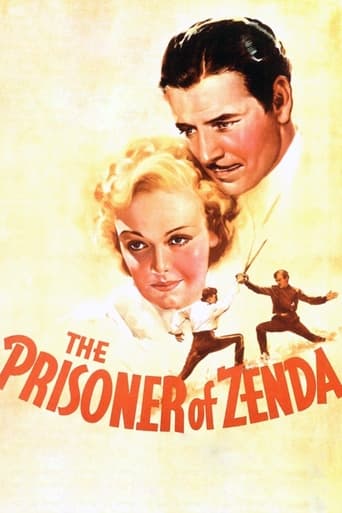
The Prisoner of Zenda (1937)
The most thrilling swordfight ever filmed...
A kingdom's ascending heir, marked for assassination, switches identities with a lookalike, who takes his place at the coronation. When the real king is kidnapped, his followers try to find him, while the stand-in falls in love with the king's intended bride, the beautiful Princess Flavia.
- Date of release
- 1937-09-03
- TMDB
- 7.5 / 10 (64)
- Runtime
- 1h 41m
- Genres
- Romance, Adventure
- Director
- John Cromwell
Casting
- Ronald Colman — Major Rudolf Rassendyll / The Prisoner of Zenda
- Madeleine Carroll — Princess Flavia
- Douglas Fairbanks Jr. — Rupert of Hentzau
- Mary Astor — Antoinette de Mauban
- C. Aubrey Smith — Colonel Zapt
- David Niven — Captain Fritz von Tarlenheim
- Raymond Massey — Black Michael
- Montagu Love — Detchard
- Philip Sleeman — Albert von Lauengram
- Eleanor Wesselhoeft — Frau Holf the Cook
- Torben Meyer — Max the Butler
- Wilhelm von Brincken — Krafstein (uncredited)
Interesting facts
- Based on: The Prisoner of Zenda
- Awards: 0 · Nominations: 2
The Prisoner of Zenda is a 1937 American black-and-white adventure film based on Anthony Hope's 1894 novel and the 1896 play. A lookalike impersonates his royal distant relative when the royal is kidnapped to prevent his coronation. This version is widely considered the best of the many film adaptations of the novel and play.
Production
Douglas Fairbanks Jr. initially wanted to play Rudolf, but when the role went to Colman, his father, Douglas Fairbanks, told him "not only is The Prisoner of Zenda one of the best romances written in a hundred years and always a success, but Rupert of Hentzau is probably one of the best villains ever written".
When the play opened in London in January 1896, C. Aubrey Smith had played the dual lead roles. Massey asked Smith for advice and was told, "My dear Ray, in my time I have played every part in The Prisoner of Zenda except Princess Flavia. And I always had trouble with Black Michael!"
The orchestra conductor who is forced to cease and resume conducting the Künstlerleben Walzer by Strauss every time the royal couple stop and start waltzing was played by Al Shean, uncle of the Marx Brothers (Groucho, Harpo, Chico and Zeppo) as well as half the earlier comedy team Gallagher and Shean.
Former Prince of Sweden Sigvard Bernadotte was working in Hollywood at the time and was credited as a technical advisor.
This production was "one of the last great gatherings of the Hollywood English" before World War II. Selznick was partly inspired to take on the project because of the abdication of Edward VIII, and exploited this angle in his marketing of the film.
Read on Wikipedia · Text from Wikipedia, CC BY-SA 4.0. Data from Wikidata.
Recommended
- The Prisoner of Zenda 1952 · ★ 6.9
- The Man in the Iron Mask 1977 · ★ 6.4
- The Vikings 1958 · ★ 7.0
- Prince Valiant 1954 · ★ 6.1
- Scaramouche 1952 · ★ 7.0
- The Three Musketeers 1948 · ★ 6.8
- Jack the Giant Killer 1962 · ★ 6.6
- The Sea Hawk 1940 · ★ 7.2
- The Three Musketeers 1973 · ★ 6.7
- Once Upon a Prince 2018 · ★ 6.5
- The Prince and the Pauper 1962 · ★ 7.2
- Krull 1983 · ★ 6.1