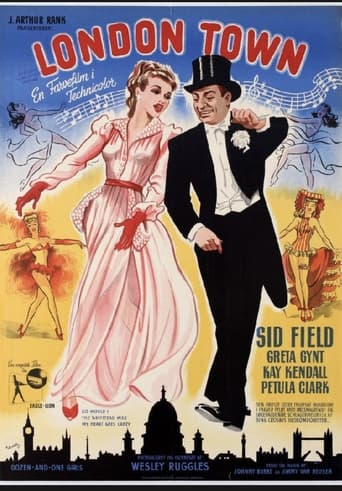
London Town (1946)
Veteran music-hall entertainer Jerry Stanford a washed-up comedian hopes to stage a comeback in a glittering new revue. Alas, Stanford is hired as merely an understudy and bit player. His faithful daughter pulls a few fast ones in order to get her dad back on stage in a starring role....
- Date of release
- 1946-09-30
- TMDB
- 10.0 / 10 (1)
- Runtime
- 2h 6m
- Genres
- Comedy, Music
- Director
- Wesley Ruggles
Casting
- Greta Gynt — Mrs. Eve Barry
- Petula Clark — Peggy Sanford
- Kay Kendall — Patsy
- Sonnie Hale — Charlie de Haven
- Claude Hulbert — Belgrave, Charlie's dresser
- Mary Clare — Mrs. Gates
- Tessie O'Shea — Herself
- Jerry Desmonde — George
- Ann Sullivan — Singer in 'Street Scene' (uncredited)
- Sid Field — Jerry Sanford
Interesting facts
London Town is a 1946 Technicolor musical film directed by Wesley Ruggles and starring Sid Field and Petula Clark. The screenplay was by Sig Herzig, Val Guest, and Elliot Paul, based on a story by Ruggles.
Production
Financed by the Rank Organisation at a time of rationing and shortages of materials in the period immediately after World War II, it was filmed in the shell of "Sound City Shepperton", which had been made available as a film studio after being requisitioned during the war as a factory for aircraft parts.
Music Hall performer Field had cheered up wartime London audiences with his hugely successful stage variety shows, including Strike a New Note (1943), Strike it Again (1944), and Piccadilly Hayride (1946), so he seemed a natural for the lead. As he was of the opinion that no British director was capable of making a good musical, he insisted on having an American at the helm, and the task fell to Wesley Ruggles, who produced as well.
Val Guest said he did not write the script, but he "did a script of all Sid's stuff" because they had worked together on stage. He continued, "Wes Ruggles needed somebody firm on top of him and he didn’t have anybody. I think they were overawed by his “weight” [gravitas] because his biography read like movie history. It just didn’t hang together, it was a very bad script".
Kay Kendall was promoted as England's answer to Lana Turner. "Nobody had ever heard of me but they called me a star", she later recalled. "I opened bazaars, signed autographs, went to premieres, [and] did everything a star was supposed to do. My photograph was on magazine covers and front pages of newspapers. And all before we'd ever finished the picture."
Read on Wikipedia · Text from Wikipedia, CC BY-SA 4.0. Data from Wikidata.
Recommended
- A Song Is Born 1948 · ★ 6.5
- Love Happy 1949 · ★ 5.8
- Babes in Arms 1939 · ★ 6.4
- Footlight Parade 1933 · ★ 6.8
- The Big Store 1941 · ★ 6.3
- CB4 1993 · ★ 6.1
- A Day at the Races 1937 · ★ 7.1
- The Cocoanuts 1929 · ★ 6.5
- Sneakerella 2022 · ★ 5.9
- This Is Spinal Tap 1984 · ★ 7.4
- The Rocker 2008 · ★ 6.1
- Wayne's World 1992 · ★ 6.7