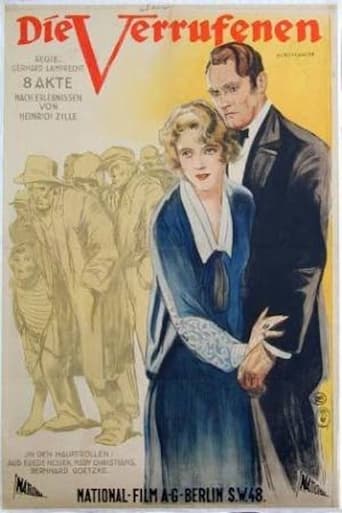
Die Verrufenen (1925)
It was not just the children who were treated badly by the wealthy Weimar republic. Robert Kramer is released from prison but struggles to adjust to civilian life. His father disowns him, his wife has left him for another man. There is no work. He eventually arrives in a shelter for the homeless, and seeks salvation through Emma, a prostitute.
- Data di uscita
- 1925-08-28
- TMDB
- 4.9 / 10 (8)
- Durata
- 1 h 53 min
- Generi
- Dramma
- Regista
- Gerhard Lamprecht
Cast
- Bernhard Goetzke — Robert Kramer
- Paul Bildt — Herr Kramer - Roberts Vater
- Aud Egede-Nissen — Emma
- Arthur Bergen — Gustav
- Mady Christians — Regine Lossen
- Christian Bummerstaedt — Regines Bruder
- Eduard Rothauser — Rottmann
- Hildegard Imhoff — Gerda
- Margarete Kupfer — Verwalterin
- Frida Richard — Frau Heinicke
- Frigga Braut — Waschfrau
- Georg John — Waschfraus Mann
Curiosità
Slums of Berlin is a 1925 German silent drama film directed by Gerhard Lamprecht, based on the experiences of Heinrich Zille. Featuring performances by Aud Egede-Nissen, Bernhard Goetzke, and Mady Christians, it is one of three 'milieu' films by Lamprecht, often referred to as Zille films in homage to their inspiration. Originally intended to be titled Der fünfte Stand, the film was renamed after its completion. The intertitle card displays Die Verrufenen with Der fünfte Stand shown in brackets and smaller text. The film was shot at the Marienfelde Studios in Berlin, with sets designed by the art director Otto Moldenhauer. It was both produced and distributed by National Film.
Production
The film's production was initiated and supported by Adolf Heilborn, the brother of Lamprecht's collaborator Luise Heilborn-Körbitz, who was a doctor, writer, and a personal friend of Heinrich Zille. While Erich Pommer of "Decla-Bioscop" and the producers at "Gloria" considered the subject matter unpopular and hesitated to pursue it, Lamprecht found an ally in Franz Vogel, whom he knew from Eiko Film and who, in 1925, was a producer at National F…
The film's sets were created by Otto Moldenhauer, and the cinematography was by Karl Hasselmann. The film was made at the "Terra-Glashaus" studios in Marienfelde, Berlin-Tempelhof, and was submitted for censorship review on 20 July 1925. Its premiere took place on 28 August 1925 at the "Tauentzien-Palast" and simultaneously at the "Union-Theater" Turmstraße.
The film reached the United States two years later, on 25 January 1927, where it was titled "Slums of Berlin." It also achieved great success abroad, and was shown in France, Spain, Finland, and Japan.
Leggi su Wikipedia · Testo da Wikipedia, CC BY-SA 4.0. Dati da Wikidata.
Consigliati
- Domenica 2018 · ★ 5.8
- Eleanor the Great 2025 · ★ 6.8
- Gli effetti dei raggi gamma sui fiori di Matilde 1972 · ★ 7.3
- La strada che scegli 2019 · ★ 6.9
- The German Lesson 2019 · ★ 6.5
- Winged Creatures - Il giorno del destino 2009 · ★ 5.9
- La Riffa 1991 · ★ 6.9
- Favolacce 2020 · ★ 6.7
- Lorelei 2020 · ★ 6.0
- All Day and a Night 2020 · ★ 6.3
- Someday We’ll Tell Each Other Everything 2023 · ★ 5.8
- La messa è finita 1985 · ★ 7.4