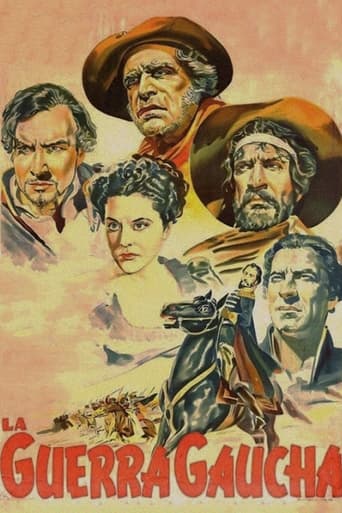
The Gaucho War (1942)
La guerra gaucha
The story of the irregular forces on the north of Argentina, fighting against the Spanish Crown for the independence.
- Date of release
- 1942-11-20
- TMDB
- 6.7 / 10 (9)
- Runtime
- 1h 30m
- Genres
- History, Drama, War
- Director
- Lucas Demare
Casting
- Enrique Muiño — Sacristán Lucero
- Francisco Petrone — Capitán Miranda
- Sebastián Chiola — Capitán Del Carril
- Ángel Magaña — Teniente Villareal
- Amelia Bence — Asunción Colombres
- Ricardo Galache
- Dora Ferreiro
- Elvira Quiroga
- Juan Pérez Bilbao
- René Múgica
- Carlos Campagnale — Niño
- Roberto A. Combi
Interesting facts
The Gaucho War is a 1942 Argentine historical drama and epic film directed by Lucas Demare and starring Enrique Muiño, Francisco Petrone, Ángel Magaña, and Amelia Bence. It is one of the most celebrated works of the Golden Age of Argentine cinema. The film's script, written by Homero Manzi and Ulyses Petit de Murat, is based on the novel by Leopoldo Lugones published in 1905. The film premiered in Buenos Aires on November 20, 1942, and is considered by critics of Argentine cinema to be one of the most successful films in history.
Production
Leopoldo Lugones (June 13, 1874 – February 18, 1938) was a prolific Argentine writer and journalist of whom Ricardo Rojas said:
"His verbal inventiveness was tremendous and he went through all the literary schools; as his mind was impressionable and he went through all the political parties. The variety of his themes, genres, and styles, in verse and in prose, is the most evident characteristic of his "complete works", if looked at as a whole, even though if they are studied separately his erudition can be appreciated, the fantasy, the verbal richness."
To write La guerra gaucha Lugones traveled to Salta Province, to visit the actual places where the events happened and to record the oral tradition of the area. It is an epic story composed of several histories described with a wide vocabulary full of metaphors. Dialogs are short, but descriptions and subjective vision are plentiful. The landscape characteristics and Salta's nature are described in detail and have great importance in the book.
On February 20, 1938 Roberto M. Ortiz became president of Argentina. A member of the Unión Cívica Radical Antipersonalista party, he expressed his intention of ending the systemic electoral fraud imposed since the 1930 military coup. This idea found resistance within the political coalition named "The Concordance" ("La Concordancia") to which he belonged.
At the start of World War II the Argentine government declared itself neutral (on September 4, 1939), repeating the position taken during the First World War (1914–1918). Great Britain supported the decision as it was interested in Argentina being neutral and continuing the supply of food during the war.
Read on Wikipedia · Text from Wikipedia, CC BY-SA 4.0. Data from Wikidata.
Recommended
- Outlaws - For Greater Glory 2012 · ★ 7.0
- Field of Lost Shoes 2015 · ★ 6.1
- Walking with the Enemy 2014 · ★ 6.3
- The Kill Team 2019 · ★ 6.5
- The Truce 2025 · ★ 6.5
- The Scarlet and the Black 1983 · ★ 7.1
- Waiting for Anya 2020 · ★ 6.3
- Battleground 1949 · ★ 6.7
- The Last Rifleman 2023 · ★ 6.6
- Bonhoeffer: Pastor. Spy. Assassin 2024 · ★ 6.7
- Behold a Pale Horse 1964 · ★ 6.0
- Firebrand 2024 · ★ 6.3